



The world of e-commerce is constantly evolving, and one of the most powerful shifts we've seen in recent years is the rise of the subscription economy. If you're running a Shopify store and not yet exploring recurring revenue, you're leaving a significant amount of potential on the table. This guide by Recurpay will walk you through the best Shopify subscription apps, helping you choose the perfect partner to build a thriving subscription business.
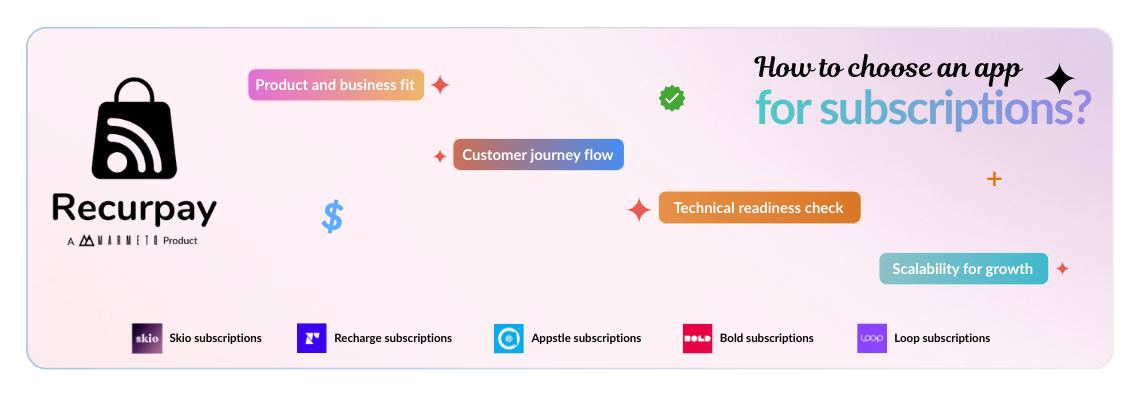
The subscription economy: this is why every shopify store should consider recurring revenue
Imagine a customer who buys from you once and then disappears. Now, imagine a customer who buys from you every month, consistently contributing to your bottom line. That's the power of recurring revenue. In today's competitive landscape, building a stable, predictable income stream is no longer a luxury – it's a strategic necessity. Subscriptions transform one-time buyers into loyal patrons, fostering a deeper relationship and significantly increasing their lifetime value.
From coffee beans to craft supplies, pet food to personal care, nearly any product or service can be transformed into a subscription offering. It provides convenience for your customers and invaluable predictability for your business operations, inventory management, and cash flow forecasting.
What exactly is a shopify subscription app?
At its core, a Shopify subscription app isa specialized tool that integrates with your Shopify store to enable and manage recurring payments and deliveries. It allows your customers to sign up for products or services that are automatically charged and shipped (or delivered digitally) at set intervals – weekly, monthly, quarterly, or annually.
Think of it as the engine that powers your subscription program. It handles everything from the initial sign-up and recurring billing to customer portal management (where subscribers can manage their own subscriptions) and crucial notifications. Without a robust subscription app, managing even a small number of recurring orders would be a logistical nightmare.
What we looked for in the best shopify subscription apps
Choosing the right subscription app isn't just about picking the one with the most features; it's about finding the best fit for your unique business needs. As we evaluated the top contenders, we focused on several key criteria that separate the good from the truly exceptional.
1. Ease of integration & setup
The first hurdle for any new app is getting it up and running without pulling your hair out. We looked for apps that offer seamless integration with Shopify, allowing you to configure subscription products, billing cycles, and customer portals with minimal technical fuss. A clear, intuitive setup process means you can start generating recurring revenue faster.
2. Customization options
Your brand is unique, and your subscription experience should reflect that. The best apps offer extensive customization options, allowing you to tailor the customer portal, email notifications, built-in upsells, analytics, and win-back flows, customizable subscription plans (standard, prepaid, usage-based), subscription widgets, and checkout flow to match your brand's aesthetic and voice. All of these combined help in churn reduction and customer retention. This isn't just about pretty colors; it's about creating a cohesive and trusted brand experience that keeps customers coming back.
3. Customer experience (portal & management)
A happy subscriber is a loyal subscriber. A crucial part of this happiness comes from empowering them. We prioritized apps that provide a robust, self-service customer portal. This portal should allow subscribers to easily pause, skip, swap, or cancel subscriptions, update payment information, and change delivery addresses without needing to contact customer support. A frictionless customer experience reduces churn and builds trust.
4. Payment gateway compatibility
Not all businesses use the same payment processor. We assessed apps based on their compatibility with a wide range of popular payment gateways, including Shopify Payments, Stripe, PayPal, and more niche options. Flexibility here ensures you can continue to use your preferred payment solutions and cater to a diverse customer base.
5. Reporting & analytics
What gets measured gets managed. A powerful subscription program requires deep insights into its performance. The top apps provide comprehensive reporting and analytics, giving you data on churn rates, customer lifetime value (LTV), average revenue per user (ARPU), and subscription growth. These metrics are vital for making informed decisions and optimizing your recurring revenue strategy.
According to StoreInspect's 154,065-store study on Shopify subscription apps, only a small fraction of Shopify stores currently use subscription apps, making data-driven decision making even more critical for merchants who do.
6. Pricing structure
Subscription app pricing can vary wildly, from transaction-fee-based models to tiered monthly subscriptions. We considered how different pricing structures might impact businesses at various stages, from startups to established enterprises, ensuring transparency and value for money. The ideal app offers a pricing model that scales with your success, without penalizing you for growth.
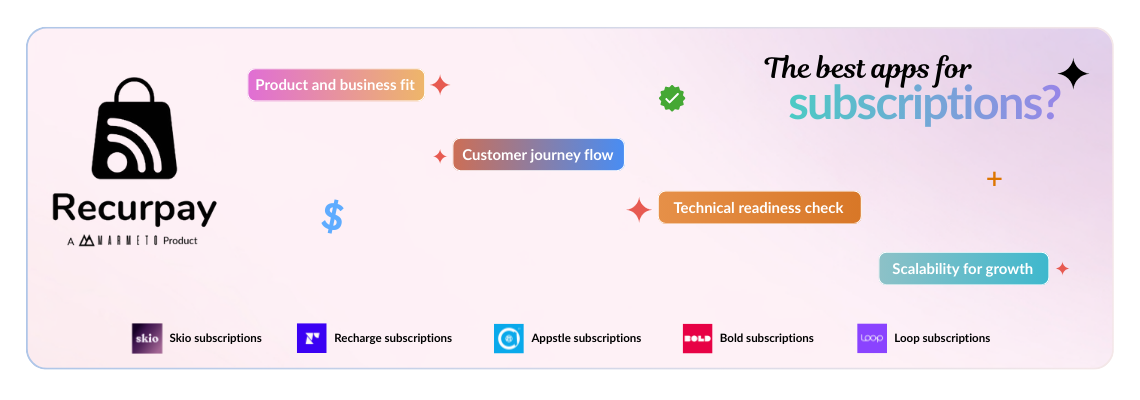
The best Shopify subscription apps compared
Now, let's dive into the apps that stood out in our evaluation. Each offers a unique blend of features and strengths, catering to different business needs and aspirations.
Recurpay subscriptions
Recurpay is the best Shopify subscription app built for merchants who want to start subscriptions quickly, scale confidently, and never feel stuck without support. It combines powerful subscription capabilities with real human assistance, making it easier for both new subscription businesses and merchants switching from other tools.
Why it stands out:
1. Fast, simple setup
Recurpay is designed to get subscriptions live in minutes. Merchants can turn one-time products into subscriptions without complex configurations or long setup cycles.
2. 24/7 live human support
Unlike many tools that rely on tickets or bots, Recurpay offers 24/7 human support. Merchants know that help is always available, especially critical during setup, migration, or billing issues.
3. Flexible subscription models
Recurpay supports both upfront and pay-as-you-go subscriptions, along with flexible renewals, trials, and billing dates. This makes it easy to offer subscriptions that fit different customer buying behaviors.
4. Customer-friendly subscription management
Customers can manage their own subscriptions through a clean portal, skipping, rescheduling, pausing, or canceling anytime. This reduces support load while improving customer experience and trust.
5. Built for switching with confidence
Recurpay offers free white-glove migrations from other subscription apps, helping merchants move without risking existing subscribers or revenue.
6. Developer-friendly
For teams that want deeper customization, Recurpay provides full access to APIs, code, and technical support, without forcing complexity on merchants who don’t need it.
7. Best for:
Merchants who want a trusted Shopify subscription app that is easy to start, flexible to grow with, and backed by real human support, whether they’re launching subscriptions for the first time or switching from an existing solution.
Recharge subscriptions
Recharge is often considered the enterprise heavyweight in the Shopify subscription ecosystem. It has been around for years and is widely adopted by large, established brands with complex requirements.
Why it stands out:
1. Robust feature set
Recharge offers a very broad set of features, including flexible billing models, advanced dunning, detailed analytics, and a comprehensive customer portal.
2. Deep integrations
It integrates with a large ecosystem of third-party tools, making it suitable for merchants with mature, interconnected tech stacks.
3. Scalability
Built to handle high subscription volumes, Recharge is commonly used by enterprise and high-growth brands.
4. Developer-friendly
Extensive API access allows for deep customization, though it often requires technical resources to fully leverage.
5. Best for:
Large or enterprise businesses that need maximum configurability and already have the technical bandwidth to manage a complex subscription setup.
Loop subscriptions
Loop positions itself as a feature-rich challenger, with a strong focus on automation, loyalty, and engagement-driven subscription experiences.
Why it stands out:
1. Advanced automation & workflows
Loop enables complex logic-based workflows tied to subscriber behavior.
2. Loyalty & gamification
Features like referrals, build-a-box, and gifting help brands create highly engaging subscription programs.
3. Modern customer portal
A customizable and intuitive portal gives subscribers significant control.
4. Strong support
Often praised for responsiveness, particularly when setting up advanced flows.
5. Best for:
Brands that want to build deeply automated, engagement-heavy subscription experiences and are comfortable managing more complexity.
Appstle subscriptions
Appstle is known for offering a wide range of subscription features at competitive pricing, making it a popular choice among growing businesses.
Why it stands out:
1. Feature-rich at a value price
Includes many advanced features typically found in higher-priced tools.
2. Excellent customer support
Support quality is frequently highlighted by users.
3. User-friendly interface
Generally approachable for merchants without deep technical expertise.
4. Retention tools
Includes built-in tools aimed at reducing churn.
5. Best for:
Small to mid-sized businesses that want strong functionality at a cost-effective price point.
Bold subscriptions
Bold subscriptions is part of the broader Bold Commerce ecosystem and is known for handling complex billing and bundle-based subscription models.
Why it stands out:
1. Highly flexible billing
Supports advanced billing logic and hybrid subscription models.
2. Bundles & build-a-box
Strong choice for customizable subscription boxes.
3. Extensive integrations
Works well within the Bold Commerce toolset.
4. Robust API
Offers deep customization for technical teams.
5. Best for:
Merchants with complex subscription structures or those already using other Bold Commerce products.
Skio subscriptions
Skio is a modern, headless-first subscription platform focused on performance and developer control.
Why it stands out:
1. Headless-first design
Optimized for speed and custom front-end experiences.
2. Passwordless login
Reduces friction for subscriber access.
3. Focus on retention
Smart cancellation and skip flows designed to save subscriptions.
4. Modern UI/UX
Clean, fast interfaces for both merchants and customers.
5. Best for:
Tech-forward D2C brands prioritizing speed, headless architecture, and advanced front-end control.
Seal subscriptions
Seal subscriptions is positioned as an affordable entry point for merchants new to subscriptions.
Why it stands out:
1. Free plan available
Allows merchants to start without upfront costs.
2. No transaction fees (on paid plans)
Can be cost-effective as subscription volume grows.
3. Solid feature set
Includes core subscription functionality and dunning.
4. Reliable support
Often noted as helpful for beginners.
5. Best for:
Startups or small businesses testing subscriptions with minimal initial investment.
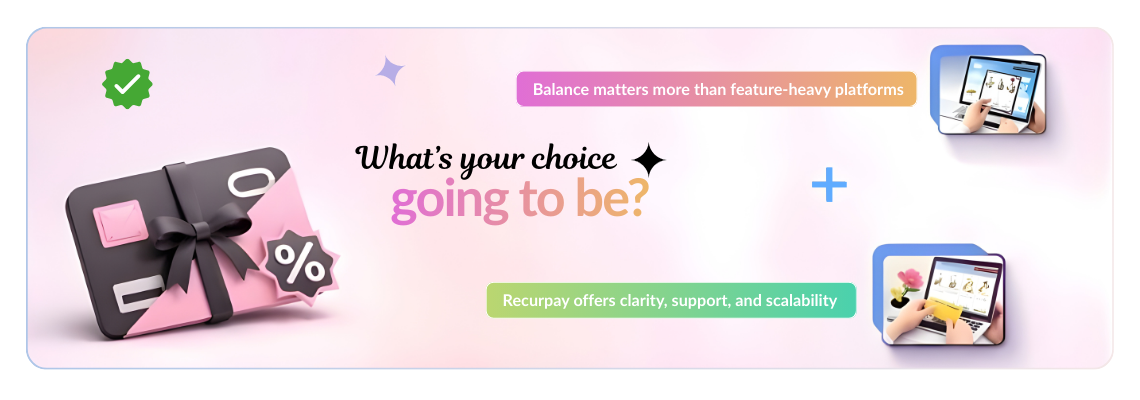
Choosing the right subscription app for your Shopify store
Navigating the options can feel overwhelming, but by asking yourself a few key questions, you can narrow down the field and find your perfect match.
1. Consider your product & business model
The type of product you sell will heavily influence your app choice. Are you selling a single, recurring product (like coffee beans)? Or are you offering a highly customizable subscription box where customers can pick and choose items (like beauty products)? If it's the latter, features like "build-a-box" and complex bundling capabilities will be crucial. If you're selling digital subscriptions, ensure the app supports digital product delivery. Your business model also dictates billing frequency, which all these apps handle, but some excel at more complex, dynamic pricing models.
2. Think about your customer journey
Visualize your ideal customer's experience from discovery to ongoing subscription management. Do you want them to have absolute control over skipping, swapping, or pausing orders? Do you anticipate needing a highly personalized communication strategy? An app with a strong, self-service customer portal and advanced automation capabilities (like Recurpay) will empower your customers and reduce your support load. If your customer base is less tech-savvy, a simpler, straightforward portal might be better.
3. Evaluate your technical prowess (or your team's)
Be honest about your technical comfort level. Are you comfortable digging into code and APIs for deep customization, or do you prefer a drag-and-drop interface? Apps like Recurpay and Bold offer extensive developer flexibility, while others like Appstle and Seal prioritize ease of use for non-technical merchants. If you plan to outsource development or have an in-house team, a developer-friendly API can unlock incredible possibilities. If not, opt for an app that's easy to configure out-of-the-box.
4. Don't forget about scalability
Even if you're starting small, think big. Will your chosen app comfortably handle 100, 1,000, or even 10,000 subscribers? What are the pricing implications as you grow? Some apps have pricing tiers that become very expensive at scale, unlike Recurpay which offers more affordable, predictable, percentage-based fees. Ensure the app can grow with you without requiring a costly and disruptive migration down the line. Look at their enterprise client lists for proof of concept.
Tips for a successful subscription program on shopify
Simply installing an app isn't enough; success comes from a well-thought-out strategy and consistent execution.
Offer flexibility
Customers value control. Allow them to easily pause, skip, swap products, or change their delivery frequency. The more control you give them, the less likely they are to cancel. Think of it as empowering them to adapt the subscription to their life, rather than forcing them into a rigid schedule. This flexibility is a powerful churn-reduction tool.
Focus on value, not just discounts
While discounts can attract initial sign-ups, true loyalty is built on perceived value. What unique benefit does your subscription offer? Is it convenience, exclusivity, curation, or significant savings over one-time purchases? Articulate this value proposition clearly. A customer who understands the ongoing benefit is far more likely to stick around than one who only signed up for a 10% off coupon.
Communicate clearly and often
Transparency builds trust. Clearly communicate upcoming charges, shipping dates, any changes to their subscription, and instructions on how to manage their account. Use automated emails for these critical touchpoints. Beyond transactional emails, engage your subscribers with content that reinforces the value and community of your brand.
Make cancelling easy (seriously)
This might sound counterintuitive, but a frustrating cancellation process breeds resentment and negative reviews. A one-click cancellation option how Recurpay has already aced (perhaps with a polite "Are you sure?" and an offer to pause or skip instead), is far better than a labyrinthine process that forces customers to contact support. When cancellations are easy, customers are more likely to return later or recommend you to others, even if they're not a good fit right now.
Leverage analytics to refine your offerings
Your subscription app's analytics dashboard is your secret weapon. Pay close attention to churn rates, reasons for cancellation, product swaps, and customer lifetime value. Use this data to identify trends, optimize your product offerings, refine your marketing messages, and preempt potential problems. Continuous improvement based on data is the hallmark of a successful subscription business.
Frequently asked questions (FAQs) about Shopify subscription apps
Let's address some common concerns that arise when considering subscription services.
1. How do subscription apps handle inventory?
Most Shopify subscription apps integrate directly with your Shopify inventory management. When a recurring order is processed, the app creates a new order in Shopify, which then deducts the products from your inventory just like a regular one-time purchase. Some advanced apps like Recurapy offer pre-order or inventory forecasting features for subscription-specific products, but at a basic level, it ties into Shopify's existing system.
2. Can I migrate existing subscribers to a new app?
Yes, generally, you can. This is a critical feature for businesses looking to switch subscription providers. Most top-tier apps offer migration services or clear documentation on how to import existing subscriber data (customer details, subscription terms, payment tokens) from another app or even a spreadsheet. It's crucial to plan this carefully and communicate with both your current and new app providers to ensure a smooth transition without interrupting billing cycles or customer access.
3. What are the typical costs associated with these apps?
The costs vary widely. You'll primarily encounter two models:
Percentage-based fees: A small percentage (e.g., 0.75% to 3.5%) of your recurring revenue, often combined with a lower monthly base fee. This scales with your success.
Tiered monthly plans: Flat monthly fees that increase based on the number of active subscribers, features included, or revenue volume.
Transaction fees: Some apps might also charge a per-transaction fee in addition to a monthly plan.
Many apps offer a free trial, and some, like Recurpay & Seal subscriptions, even have a free tier for basic functionality. Always read the pricing page carefully and consider how your projected growth will impact the cost over time.
4. Are subscription apps secure for customer payment data?
Absolutely. Reputable subscription apps are PCI DSS compliant, meaning they adhere to the Payment Card Industry Data Security Standard. This is a set of security standards designed to ensure that all companies that process, store, or transmit credit card information maintain a secure environment. Instead of storing sensitive credit card details directly, these apps typically use tokenization. This means they receive a unique, encrypted "token" from the payment gateway that represents the customer's card, making it impossible for malicious actors to access actual card numbers even if a breach were to occur. Your customer's payment information is handled with the highest level of security.
Final takeaway: so, which shopify subscription app should you choose?
If there’s one clear takeaway from this guide, it’s that there is no single “one-size-fits-all” subscription app, but there is a best starting point for most Shopify merchants.
Some apps on this list are built for highly complex, enterprise setups. Others are great for experimenting on a tight budget or for niche use cases like headless commerce or advanced gamification. Those tools shine in specific scenarios. However, for the majority of Shopify merchants, especially those who want to launch subscriptions quickly, avoid unnecessary complexity, and still have the flexibility to scale, choosing the right balance matters more than choosing the most feature-heavy platform.
This is where Recurpay stands out.
Recurpay combines the essentials of a powerful subscription system with something that’s often overlooked: clarity and real human support. It allows merchants to start small, validate subscriptions fast, and grow confidently without being forced into enterprise-level complexity from day one. For merchants switching from another app, the added assurance of white-glove migration and 24/7 live support further reduces risk.
In short:
If you want the most complex and deeply configurable setup, enterprise tools may be a fit.
If you’re testing subscriptions with minimal cost, simpler tools can help you experiment.
But if you’re looking for a reliable, easy-to-start, and future-proof Shopify subscription app that works for both new launches and migrations, Recurpay is the most balanced choice.
For most Shopify stores, that balance is what turns subscriptions from an idea into a sustainable, recurring revenue engine.