
.png)
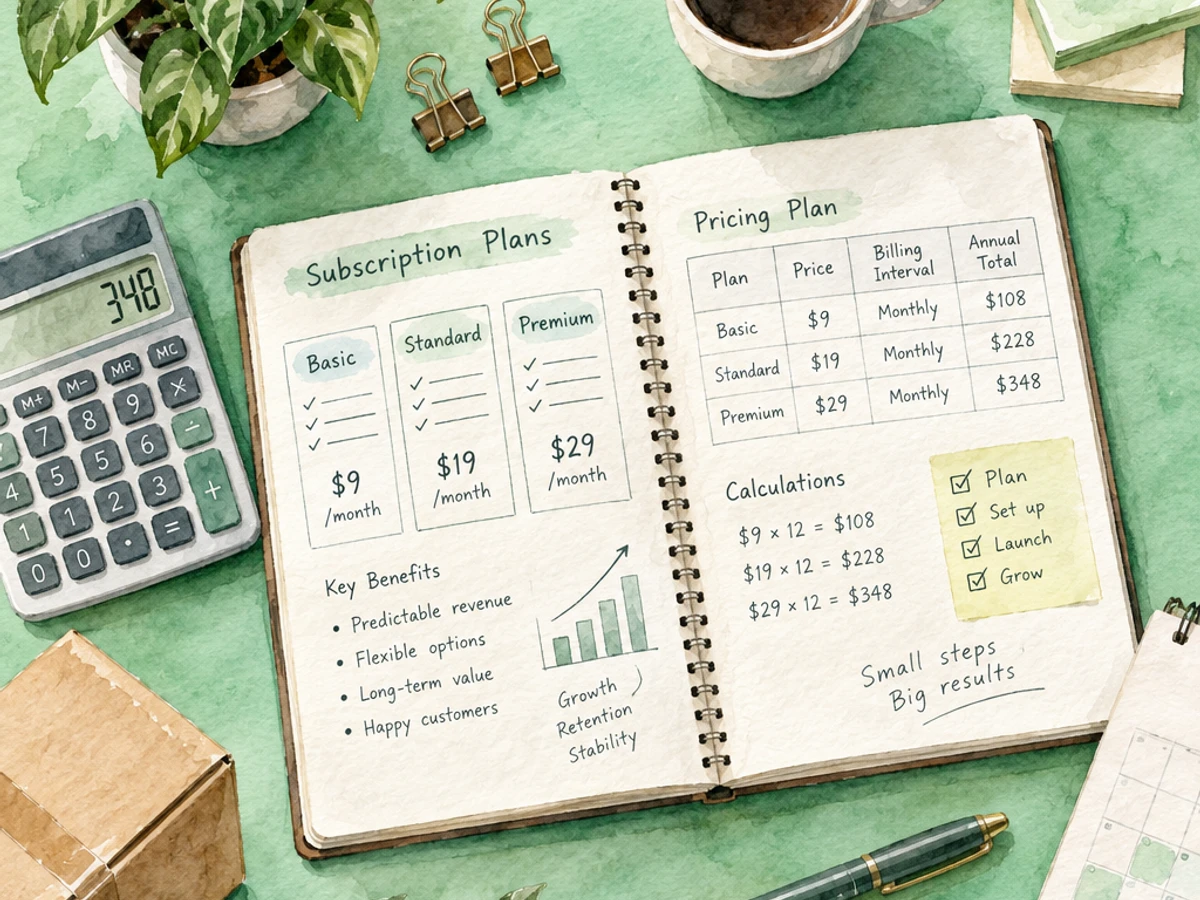
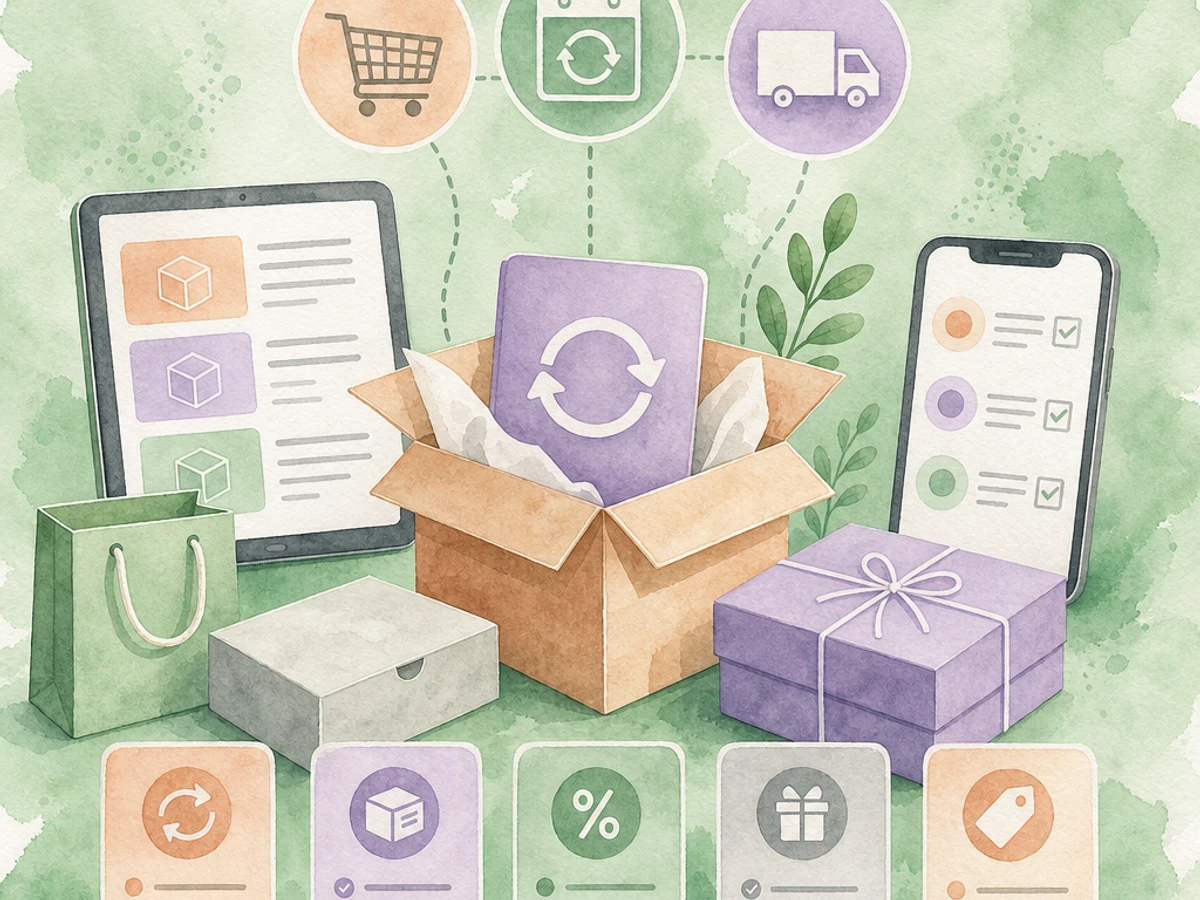
If you're looking to understand the mechanics, the power, and the potential pitfalls of this transformative approach, you've come to the right place.
You've likely encountered the subscription business model countless times, perhaps without even realizing it. From your morning news feed to your evening entertainment, from the software that powers your workday to the curated box of goodies that arrives at your door, subscriptions have woven themselves deeply into the fabric of modern commerce. But what exactly is this model, and why has it become such a dominant force in today's economy?
This isn't just about paying a monthly fee; it's about fundamentally reshaping the relationship between businesses and their customers. It's a strategic pivot that prioritizes long-term engagement over one-off transactions, stability over seasonality, and value delivery over simple product ownership.
What exactly is a subscription business model?
At its core, a subscription business model is an agreement where a customer pays a recurring fee, typically daily, weekly, monthly, or annually, to access a product, service, or content. Instead of purchasing an item outright, the customer essentially leases the right to use or receive it for a specified period. Think of it like renting a house versus buying one; you pay regularly for ongoing access and benefits, rather than a single, large sum for ownership.
This model is a powerful departure from traditional transaction-based commerce. In the old paradigm, a sale was often the end of a relationship, a handshake goodbye. With subscriptions, a sale is just the beginning. It's the first step in an ongoing journey where both parties have a vested interest in the continuous delivery and reception of value. This shifts the focus from simply selling a product to fostering an enduring relationship built on consistent utility and experience.
Beyond the monthly fee: Understanding the core value
To truly grasp the essence of the subscription model, we need to look beyond the mechanics of the recurring payment. The real magic lies in the value exchange it facilitates. For the customer, it's about convenience, predictability, and often, continuous improvement. They don't have to worry about running out, replacing, or updating; the service or product is simply there, evolving and adapting to their needs.
Consider a software subscription. You're not just paying for a static program; you're paying for ongoing updates, new features, security patches, and support. The value isn't a fixed point but a continuous stream. Similarly, a coffee subscription isn't just about getting coffee beans; it's about the consistent ritual, the discovery of new roasts, and the peace of mind that you'll never run out of your morning brew. The recurring payment is simply the mechanism for accessing this continuous stream of value. It's about access, not ownership; experience, not just exchange.
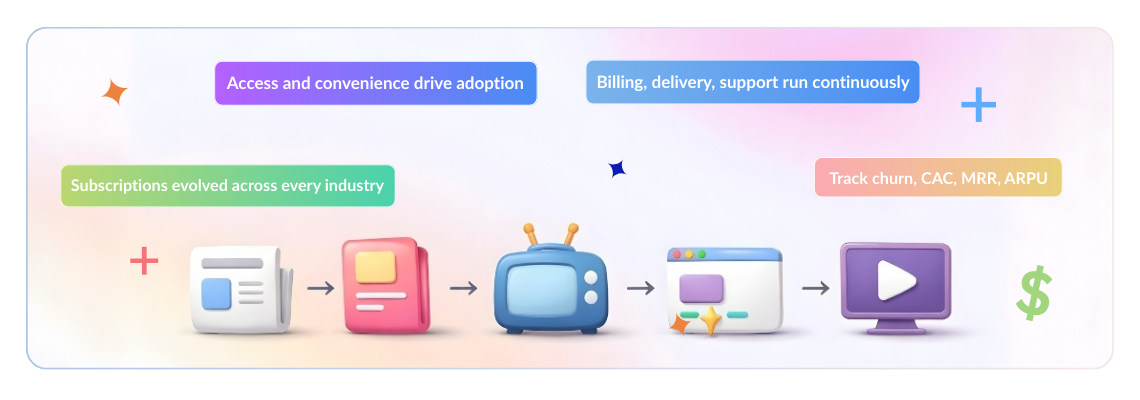
The historical roots of recurring revenue
While the subscription model feels distinctly modern, its roots stretch back much further than Netflix or Spotify. The concept of paying for ongoing access or goods is far from new. Imagine a world without instantaneous communication or mass production, where information and essential supplies were far more precious.
One of the earliest and most enduring examples can be found in the publishing industry. For centuries, patrons would "subscribe" to newspapers, journals, or even entire sets of books, agreeing to pay a regular sum in exchange for future editions or volumes as they were produced. This provided publishers with predictable income and allowed readers to stay consistently informed. Libraries, too, operated on a form of recurring access, often funded by community subscriptions or memberships.
From newspapers to software: A timeline of evolution
The evolution of the subscription model is a fascinating journey that mirrors technological and societal advancements:
- 17th & 18th centuries: The birth of newspaper and journal subscriptions in Europe. Early patrons would fund publications in advance, ensuring a steady stream of information.
- 19th century: Book clubs emerge, offering subscribers curated selections of books delivered periodically. Utilities like gas, water, and electricity also began operating on a recurring payment model, though often not explicitly termed "subscriptions."
- Early 20th century: Magazine subscriptions become widespread, offering specialized content to niche audiences. Early milk and bread delivery services also exemplify a product subscription model.
- Mid-20th century: The rise of record clubs and mail-order product catalogs, providing curated goods on a recurring basis. Cable television introduces the concept of paying for ongoing access to a bundle of content channels.
- Late 20th century: Software enters the scene. Initially sold with perpetual licenses (one-time purchase), the advent of the internet paved the way for "Software as a Service" (SaaS). Companies like Salesforce pioneered this model, where businesses paid a recurring fee to access and use software applications hosted in the cloud, rather than installing them on their own servers. This was a game-changer, fundamentally altering how businesses consumed technology.
- 21st century (the subscription boom): The digital age truly ignites the subscription economy. Services like Netflix (streaming entertainment), Spotify (music), Amazon Prime (e-commerce benefits), and countless others demonstrate the immense power of recurring digital access. Physical product subscriptions also see a resurgence with curated boxes (Birchbox, Dollar Shave Club), meal kits (Blue Apron), and replenishable goods.
This timeline clearly illustrates a fundamental shift: from niche offerings and physical goods to pervasive digital services, the core idea of recurring value exchange has adapted and thrived across industries, culminating in the ubiquitous model we see today.
Why now? The driving forces behind the subscription surge
It's not just a trend; it's a fundamental shift in consumer preference and business strategy. While the concept has historical roots, several powerful forces have converged in recent decades to propel the subscription model to unprecedented prominence. Understanding these drivers is key to appreciating its current and future significance.
Predictable revenue: The north star for businesses
Imagine running a business where every month, you start from zero, hoping enough customers will walk through the door to cover your costs. This is the reality for many traditional businesses. Now, imagine knowing with reasonable certainty how much revenue will come in next month, and the month after that. This is the promise of predictable revenue, and it's a game-changer for businesses.
For executives and investors, predictable revenue is like a steady heartbeat. It allows for better financial planning, easier forecasting, and more confident investment in growth initiatives. Instead of constantly chasing the next sale, companies can focus on retaining existing customers and incrementally growing their recurring base. This stability reduces risk, makes businesses more attractive to investors, and provides a solid foundation for long-term strategic decisions. It transforms a business from a roller coaster of transactional highs and lows into a smoother, more sustainable climb.
Customer lifetime value (CLV): The long game
Traditional business often focused on the immediate profit from a single transaction. The subscription model completely flips this script, prioritizing Customer Lifetime Value (CLV). CLV is the total revenue a business can reasonably expect from a single customer account over the entire period of their relationship.
When a customer subscribes, they are no longer just a one-time buyer; they become an asset. Every interaction, every positive experience, every month they remain subscribed, increases their CLV. This shift encourages businesses to invest in customer satisfaction, support, and product improvement, knowing that these efforts will directly translate into sustained revenue over time. It's a strategic move from short-term transactional thinking to a long-term relationship-building approach, where the real value isn't in the initial conversion, but in the sustained engagement.
Enhanced customer relationships: Building loyalty, not just sales
The recurring nature of the subscription model inherently fosters deeper, more meaningful customer relationships. When customers commit to a regular payment, they expect ongoing value and a certain level of engagement. This creates a powerful feedback loop. Businesses are incentivized to listen to their subscribers, understand their evolving needs, and continuously improve their offerings.
Think of your favorite streaming service. They're constantly adding new content, refining their interface, and personalizing recommendations. This isn't just good business; it's a necessity for retention. For the customer, this continuous engagement can build a sense of loyalty and even belonging. They feel heard, their needs are met, and the service often becomes an integral part of their daily routine. This goes far beyond a simple vendor-client dynamic; it cultivates a partnership where both sides benefit from the ongoing interaction.
Scalability and efficiency: Growing without linear costs
One of the most attractive aspects of the subscription model, particularly for digital products and services, is its inherent scalability and efficiency. Once the core infrastructure is in place, adding new subscribers often doesn't incur proportional increases in cost.
For a SaaS company, for example, the cost of serving an additional customer is typically marginal compared to the initial development and infrastructure investment. This allows for significant leverage: as the subscriber base grows, revenue can increase much faster than costs, leading to expanding profit margins. This efficiency is less pronounced for physical product subscriptions (where each new subscriber still requires a new product to be manufactured and shipped), but even there, economies of scale in procurement and logistics can offer advantages. This ability to grow revenue exponentially without a linear increase in operational costs is a powerful engine for rapid and sustainable expansion.
How the subscription model actually works: The mechanics
Understanding the "why" is crucial, but the "how" brings it to life. The subscription model, while seemingly simple from the outside, involves a sophisticated interplay of customer acquisition, ongoing value delivery, and robust backend management. It's a continuous cycle designed to attract, retain, and delight customers over the long haul.
The front end: attracting and onboarding subscribers
The journey begins with attracting potential subscribers. This involves all the traditional elements of marketing and sales, but with a unique twist: the goal isn't just a one-time purchase, but a long-term commitment.
- Value proposition clarity: Businesses must articulate the specific, ongoing value a subscription offers. What problem does it solve consistently? What benefits accrue over time?
- Marketing & acquisition: This involves digital advertising, content marketing, social media engagement, and often, compelling introductory offers (free trials, discounted first months). The aim is to make the initial commitment feel low-risk and high-reward.
- Seamless onboarding: Once a potential customer decides to subscribe, the onboarding process is critical. It needs to be intuitive, informative, and immediately showcase the value. Think of how streaming services guide you to create your profile and start watching, or how a software subscription walks you through initial setup. A smooth onboarding experience sets the stage for long-term engagement and reduces early churn. It's the first taste of the ongoing value, and it needs to be delicious.
The back end: managing subscriptions and deliverables
Behind the scenes, a robust infrastructure is working tirelessly to keep the subscription engine running. This is where the heavy lifting happens, ensuring seamless recurring payments and consistent value delivery.
- Subscription management platforms: These are specialized software systems that handle the complexity of recurring billing. They track subscriber data, manage payment schedules, process renewals, handle upgrades/downgrades, and manage cancellations. Without these, managing a large subscriber base would be an administrative nightmare.
- Payment gateways: Securely process credit card information and facilitate recurring charges.
- Content/product delivery: For content subscriptions, this means maintaining servers, ensuring smooth streaming, and updating libraries. For physical product subscriptions, it involves inventory management, fulfillment, and logistics to ensure timely delivery of goods.
- Customer support: An absolutely critical component. Subscribers expect prompt and effective support for billing issues, technical problems, or general inquiries. Excellent customer service is a key driver of retention.
Pricing strategies: finding the sweet spot
Pricing in the subscription model is more art than science, requiring careful consideration of value, market demand, and perceived benefits. It's not just about setting a single price but often designing a tiered structure.
- Tiered pricing (Freemium, Basic, Premium): Many subscription services offer different levels of access or features at varying price points.
- Freemium: A free, limited version designed to attract a wide user base, with the hope of converting a percentage to paid tiers (e.g., Spotify's free tier).
- Basic/Standard: The entry-level paid offering, providing core functionality.
- Premium/Pro/Enterprise: Higher-priced tiers with advanced features, more capacity, or dedicated support, catering to power users or businesses.
- Usage-based pricing: Some subscriptions charge based on consumption (e.g., data usage, number of users, compute time). This can be appealing to customers who only pay for what they use.
- Flat-rate pricing: A single price for full access, often seen in content subscriptions.
- Perks and bundling: Offering additional benefits or bundling multiple services can increase perceived value and justify higher price points.
The "sweet spot" in pricing balances profitability with customer acquisition and retention. Too high, and you scare away potential subscribers; too low, and you undervalue your offering and struggle with sustainability. It's an ongoing process of testing, analysis, and adjustment.
Key performance indicators (KPIs) for subscription success
In the subscription world, you can't just look at sales numbers. A deeper understanding of specific metrics is crucial for diagnosing health, identifying opportunities, and steering the business toward sustainable growth. These KPIs are the vital signs of any subscription-based enterprise.
Churn Rate: the silent killer (and how to combat it)
Imagine a leaky bucket: no matter how much water you pour in, it's constantly draining out. Churn rate is that leak. It represents the percentage of subscribers who cancel or don't renew their subscriptions over a given period. It's arguably the most critical KPI because even with robust acquisition, high churn can quickly erode your subscriber base and profitability.
There are two main types:
- Customer churn: The percentage of customers lost.
- Revenue churn: The percentage of recurring revenue lost (which can be different if higher-paying customers churn).
Combating churn is an ongoing battle involving superior customer service, continuous product improvement, proactive engagement, and personalized communication. A low churn rate is a strong indicator of customer satisfaction and value delivery.
Customer Acquisition Cost (CAC): what it takes to get them
CAC is the total cost of sales and marketing efforts required to acquire a new customer. This includes advertising spend, salaries for sales and marketing teams, software, and overhead.
Formula: (Total sales & marketing costs) / (Number of new customers acquired)
Understanding your CAC is vital for profitability. If it costs you $100 to acquire a customer, and that customer only generates $50 in revenue before churning, you have a problem. Businesses aim to keep CAC significantly lower than their Customer Lifetime Value (CLV) to ensure a healthy return on investment. Optimizing CAC involves finding efficient marketing channels, improving conversion rates, and leveraging referrals.
Monthly Recurring Revenue (MRR) / Annual Recurring Revenue (ARR): the heartbeat of your business
MRR and ARR are the absolute bedrock metrics for any subscription business. They represent the predictable, recurring revenue a company expects to generate from all its active subscriptions in a given month or year.
- MRR (Monthly Recurring Revenue): The total predictable revenue generated from all active subscriptions in a month.
- ARR (Annual Recurring Revenue): MRR multiplied by 12, often used by companies with longer contract terms or higher value subscriptions.
These metrics aren't just about total sales; they reflect the health and stability of the recurring revenue stream. Growth in MRR/ARR indicates that the business is successfully acquiring new subscribers and retaining existing ones, leading to predictable and scalable income. They are the primary indicators that investors and stakeholders look at to assess the company's financial momentum.
Average Revenue Per User (ARPU): maximizing each relationship
ARPU measures the average amount of revenue generated by each active subscriber over a specific period (usually monthly).
Formula: (Total revenue) / (Number of active subscribers)
ARPU helps businesses understand the value they are extracting from their individual customer relationships. A rising ARPU can indicate successful upselling (customers moving to higher-priced tiers), cross-selling (customers adding more services), or effective price increases. It's a powerful metric for identifying opportunities to enhance customer value and, consequently, increase the revenue generated from your existing subscriber base. If your ARPU is stagnant or declining, it suggests you might be missing opportunities to provide more value or that your pricing strategy needs adjustment.
Types of subscription models: a spectrum of offerings
The beauty of the subscription model lies in its adaptability. It's not a one-size-fits-all approach but rather a flexible framework that can be tailored to a vast array of products, services, and content. While new variations constantly emerge, most fall into a few primary categories.
Content subscriptions: access to information and Eentertainment
This is perhaps the most familiar type, epitomized by digital media. The core value here is ongoing access to a library of information, entertainment, or learning materials.
- Streaming services: Netflix, Disney+, Spotify, Hulu, Apple Music. Customers pay for unlimited access to movies, TV shows, and music. The value is in the breadth of content, convenience, and personalization.
- News & journalism: The New York Times, The Wall Street Journal, Substack. Subscribers gain access to premium articles, investigative reporting, or niche newsletters, often bypassing paywalls.
- Software as a Service (SaaS): Adobe Creative Cloud, Microsoft 365, Salesforce, Zoom. Businesses and individuals pay a recurring fee to use software applications hosted in the cloud, receiving continuous updates, support, and new features. This category represents a massive segment of the B2B subscription economy.
- Online learning platforms: MasterClass, Coursera, Skillshare. Subscribers access a vast array of courses, tutorials, and certifications.
The key driver for content subscriptions is convenience and the perceived value of continuous, on-demand access to a constantly updated library of digital assets.
Product subscriptions: convenience delivered to your door
This category involves the regular delivery of physical goods directly to the customer. The value proposition here is convenience, discovery, replenishment, and often, curation.
- Curated box subscriptions: Birchbox (beauty products), Stitch Fix (clothing), BarkBox (pet products). Customers receive a surprise selection of goods tailored to their preferences, often introducing them to new brands or products.
- Replenishment subscriptions: Dollar Shave Club (razors), Chewy (pet food), Who Gives A Crap (toilet paper). These services ensure customers never run out of everyday essentials, delivering them on a predefined schedule.
- Meal kits: Blue Apron, HelloFresh, Green Chef. Customers receive pre-portioned ingredients and recipes for easy home-cooked meals, saving time on planning and grocery shopping.
- Coffee/Tea subscriptions: Many local roasters and larger brands offer regular delivery of fresh beans or tea leaves.
Product subscriptions thrive on making life easier for the customer, either by removing the need to remember to buy essentials or by providing a delightful, curated experience that saves time and effort.
Service subscriptions: solutions on demand
Service subscriptions offer ongoing access to a particular service or a bundle of services. Here, the value is in having a need consistently met or a problem continuously solved.
- Professional services: Many IT support companies, marketing agencies, or legal firms offer retainer agreements or monthly service plans. Customers pay a recurring fee for ongoing access to their expertise and support.
- Wellness & Fftness: Gym memberships, meditation apps (Calm, Headspace), personal training packages. Subscribers gain access to facilities, classes, or guided programs for their health and well-being.
- Home services: Lawn care, pest control, security monitoring. Customers pay a recurring fee for regular maintenance or protective services for their homes.
- Vehicle services: Car wash subscriptions, roadside assistance. Subscribers pay for ongoing access to specific maintenance or emergency services for their vehicles.
Service subscriptions often address a recurring need or pain point, providing peace of mind and consistent support without the customer needing to initiate a new transaction every time. It's about having a solution readily available when needed.
The advantages of adopting a subscription model
Shifting to a subscription model isn't just a business trend; it's a strategic move with profound benefits for both the companies that adopt it and the customers they serve. It fundamentally changes the relationship, fostering mutual value that extends far beyond a single transaction.
For businesses: stability, growth, and deeper insights
For businesses, the advantages are compelling and often transformative:
- Predictable revenue streams: As discussed earlier, this is the holy grail. Knowing how much revenue is coming in month after month allows for better financial planning, resource allocation, and risk management. It smooths out seasonal fluctuations and provides a stable foundation for growth.
- Increased customer lifetime Value (CLV): By converting one-time buyers into long-term subscribers, businesses unlock significantly higher revenue per customer. This encourages investment in customer retention, which is often far more cost-effective than constant acquisition.
- Stronger customer relationships: The ongoing nature of subscriptions necessitates continuous engagement. This leads to deeper understanding of customer needs, preferences, and pain points, fostering loyalty and advocacy.
- Scalability and efficiency: Especially for digital products and services, the cost of serving an additional subscriber can be marginal. This allows for rapid scaling without proportional increases in operational costs, leading to higher profit margins.
- Valuable data and insights: Every interaction, every usage pattern, every renewal or cancellation provides rich data. This information is invaluable for product development, personalization, marketing optimization, and identifying opportunities for improvement.
- Innovation and continuous improvement: With predictable revenue, businesses have the resources and incentive to constantly update, improve, and add new features to their offerings, keeping subscribers engaged and attracting new ones.
- Reduced Customer Acquisition Cost (CAC) over time: As loyal subscribers spread the word and the brand builds trust, organic growth and referrals can reduce the reliance on expensive paid acquisition channels.
For customers: convenience, value, and personalization
Customers aren't adopting subscriptions out of charity; they're doing it because it offers tangible benefits that align with modern lifestyles:
- Convenience and simplicity: No more remembering to reorder, making trips to the store, or initiating new purchases. Products and services simply arrive or are available on demand, seamlessly integrating into daily routines.
- Cost-effectiveness and predictability: While it's a recurring cost, subscriptions can often be more budget-friendly than individual purchases over time, especially for high-value services or products. Customers also appreciate the predictable monthly expense.
- Access over ownership: In many cases, customers prioritize access to an ever-evolving service or content library over outright ownership of a static product. They get more flexibility and a constantly updated experience.
- Discovery and curation: Especially with curated box subscriptions, customers enjoy the thrill of discovering new products tailored to their tastes, often saving them time and effort in research.
- Personalization and customization: Many subscription services leverage data to offer personalized recommendations, tailored product selections, or customizable service levels, enhancing the individual customer experience.
- Peace of mind: Knowing that essential items will be replenished or critical services will be consistently provided offers a sense of security and reduces mental load.
- Continuous value: Unlike a one-time purchase, the value from a subscription often grows over time with new features, content, or improvements delivered automatically.
The symbiotic relationship created by the subscription model creates a win-win scenario, where businesses gain stability and insight, and customers gain convenience, value, and a personalized experience.
The challenges and pitfalls to navigate
While the allure of predictable revenue and high CLV is strong, the subscription model is not without its complexities and potential pitfalls. It demands a different mindset and operational excellence to succeed. Overlooking these challenges can quickly turn a promising venture into a struggle.
The churn battle: keeping subscribers engaged
Churn is the boogeyman of the subscription world. It's not enough to acquire subscribers; you must relentlessly fight to keep them. The moment a customer stops seeing sufficient value for their recurring payment, they will cancel. This means:
- Constant value delivery: The product or service must consistently meet or exceed expectations. This isn't a one-and-done; it's a perpetual commitment.
- Proactive engagement: Don't wait for customers to come to you with problems. Proactively check in, offer new features, share tips, and make them feel valued.
- Addressing pain points swiftly: Billing issues, technical glitches, or delivery problems can be instant churn triggers. Excellent customer support is non-negotiable.
- Competitor pressure: The barrier to switching is often low, especially for digital subscriptions. Competitors are always vying for your subscribers' attention and dollars.
High churn negates all the benefits of recurring revenue and can quickly drain acquisition budgets. It's a continuous, strategic battle.
Pricing pressure: balancing value and profit
Finding the right pricing strategy is notoriously difficult and an ongoing challenge.
- Perceived value vs. actual cost: Customers evaluate the subscription's perceived value against its recurring cost. If the value isn't evident or consistent, price sensitivity increases.
- Market saturation: In crowded markets, differentiation becomes harder, and competitors might engage in price wars, forcing you to adjust or justify your premium.
- Feature creep vs. simplicity: Constantly adding features might increase value for some, but can also lead to complexity and higher costs for the business. Conversely, too few features can make the offering seem sparse.
- Price increases: Raising subscription prices, even justified by increased value, is always a delicate operation that risks alienating long-term customers.
The "sweet spot" is elusive and requires continuous monitoring, A/B testing, and a deep understanding of your customer segments.
Customer service excellence: it's all about the experience
In a subscription model, customer service is not just a department; it's a core retention strategy. Every interaction, good or bad, impacts the customer's decision to continue their subscription.
- High expectations: Subscribers expect quick resolutions, personalized support, and a seamless experience across all touchpoints.
- Relationship focus: Service interactions are opportunities to strengthen the relationship, not just solve a problem. Agents need to be empowered to go beyond basic troubleshooting.
- Billing and account management: Recurring billing creates unique support challenges around failed payments, upgrades, downgrades, and cancellations. These must be handled with efficiency and empathy.
A single poor customer service experience can be enough to trigger a cancellation, regardless of how good the product or service itself is.
Scaling infrastructure: growing pains are real
Successful subscription growth brings its own set of operational challenges.
- Technical scalability: For digital services, servers, databases, and network infrastructure must scale to handle increasing user loads without performance degradation.
- Fulfillment & logistics: For physical product subscriptions, managing growing inventory, packaging, and shipping logistics efficiently can become complex and costly.
- Team expansion: As the subscriber base grows, so does the demand on customer support, engineering, marketing, and operations teams. Hiring, training, and maintaining company culture become critical.
- Managing complexity: More subscribers often mean more data, more payment methods, more integration needs, and more nuanced customer segments, all of which add operational complexity.
Growing pains are inevitable, but anticipating and proactively planning for them is crucial to avoid bottlenecks and maintain service quality as the business expands.
Building your own subscription empire: a step-by-step guide
So, you're convinced the subscription model holds promise for your idea. Fantastic! But where do you begin? Building a successful subscription business isn't about throwing up a payment gateway; it's a strategic endeavor that requires careful planning and continuous execution along with some best subscription apps. Think of it as constructing a magnificent building, brick by brick.
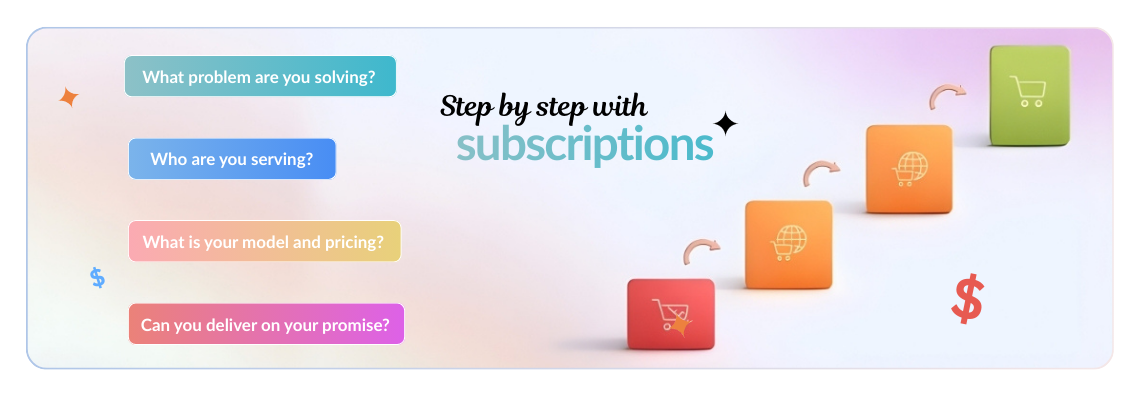
1. Define your value proposition: what problem are you solving?
This is the absolute cornerstone. Before anything else, clearly articulate the unique, ongoing value your subscription will provide. What persistent pain point are you alleviating? What recurring desire are you fulfilling?
- Are you saving people time (meal kits, software automation)?
- Are you providing consistent entertainment/information (streaming, news)?
- Are you simplifying replenishment (razors, pet food)?
- Are you fostering discovery and delight (curated boxes)?
- Are you enabling growth or efficiency for businesses (SaaS)?
Your value proposition needs to be crystal clear, compelling, and sustainable over time. This isn't just about a product; it's about a continuous benefit.
2. Identify your target audience: who are you serving?
Once you know what you're offering, you need to know who it's for. Who are the people or businesses that experience the problem you're solving most acutely?
- What are their demographics, psychographics, behaviors, and existing habits?
- What are their budgets and willingness to pay?
- Where do they spend their time online and offline? Understanding your target audience deeply will inform every subsequent decision, from product features to marketing channels to pricing.
3. Choose your subscription model and pricing: the right fit
Based on your value proposition and target audience, select the most appropriate type of subscription model (content, product, or service) and develop a preliminary pricing strategy.
- Model type: Does your offering lend itself to replenishment, curation, access, or on-demand service?
- Pricing structure: Will it be flat-rate, tiered (basic/premium), or usage-based?
- Price point: What's the perceived value? What are competitors charging? What pricing model maximizes both acquisition and CLV? Consider initial incentives like free trials or discounted first months. This is often an iterative process; be prepared to test and refine.
4. Build your product or service: deliver on your promise
Now, it's time to create the actual offering. For digital products, this means developing the software, platform, or content library. For physical products, it involves sourcing, manufacturing, and establishing supply chains. For services, it means structuring the delivery process and hiring the right talent.
- Focus on core value: Ensure the initial version strongly delivers on your defined value proposition.
- Scalability in mind: Design for future growth. Can your product/service accommodate more users/customers without a complete overhaul?
- Quality first: A subpar product or service will lead to immediate churn. The foundation must be solid.
5. Develop a marketing and sales strategy: get the word out
How will people discover your subscription? This involves crafting a compelling narrative and reaching your target audience where they are.
- Acquisition channels: Which marketing channels will be most effective (social media, paid ads, content marketing, SEO, partnerships)?
- Messaging: How will you communicate your unique value proposition to attract initial subscribers?
- Conversion funnel: How will you guide potential customers from awareness to their first subscription payment? This includes website design, landing pages, and clear calls to action.
- Trial offers: Consider free trials or introductory discounts to lower the barrier to entry and allow customers to experience the value firsthand.
6. Focus on onboarding and retention: keep them coming back
Acquisition is only half the battle. Your long-term success hinges on keeping subscribers engaged and happy.
- Smooth onboarding: Ensure new subscribers quickly understand how to use your product/service and immediately experience its value. A great first impression reduces early churn.
- Proactive communication: Regularly engage with your subscribers. Share tips, announce new features, ask for feedback, and celebrate their milestones.
- Exceptional customer support: Be responsive, helpful, and empathetic. Solve problems efficiently and turn negative experiences into positive ones.
- Continuous Improvement: Regularly gather feedback, analyze usage data, and iterate on your product or service to keep it fresh and relevant. Give them new reasons to stay.
7. Continuously innovate and adapt: stay ahead of the curve
The subscription landscape is dynamic. What works today might not work tomorrow.
- Monitor KPIs: Regularly track churn, MRR, CAC, and ARPU. These metrics will tell you what's working and what's not.
- Listen to your customers: Conduct surveys, interviews, and focus groups. Their feedback is a goldmine for innovation.
- Watch the competition: Understand what others in your space are doing well and where they fall short.
- Experiment: Don't be afraid to try new features, pricing models, or marketing approaches. Learn from both successes and failures.
Building a subscription empire is a marathon, not a sprint. It requires patience, persistence, and a relentless focus on delivering continuous value to your customers.
The future of subscriptions: what's next?
The subscription economy is far from reaching its peak; in fact, it's constantly evolving and deepening its integration into our lives. As technology advances and consumer preferences shift, we can anticipate several key trends shaping the future of subscriptions.
Hyper-personalization: subscriptions tailored just for you
Generic offerings are becoming a thing of the past. The future of subscriptions will be defined by an unprecedented level of personalization. Imagine:
- Dynamic content feeds: Streaming services that adapt not just to your viewing history, but also your mood, time of day, and even who you's watching with.
- Predictive replenishment: Subscriptions that anticipate exactly when you'll run out of a product, not just based on a fixed schedule, but on your actual usage patterns, even proactively reordering for you.
- Adaptive learning paths: Educational subscriptions that adjust curriculum difficulty and topic emphasis based on your real-time learning speed and comprehension.
- Contextual services: Software that knows when you're working on a specific project and offers relevant tools or integrations automatically.
This hyper-personalization will move beyond simple recommendations to a truly adaptive and intuitive experience, making the subscription feel indispensable because it's uniquely tailored to you.
Sustainability focus: Conscious consumption
As environmental awareness grows, so too will the demand for sustainable consumption models. Subscriptions are uniquely positioned to facilitate this shift:
- Circular economy subscriptions: Instead of owning, customers will subscribe to use products (e.g., furniture, electronics, tools) that are designed for durability, repair, and eventual return/refurbishment. This reduces waste and promotes resource efficiency.
- Eco-friendly product subscriptions: An increase in subscriptions for ethically sourced, biodegradable, or zero-waste products, making sustainable living more convenient.
- Carbon offset subscriptions: Services that help individuals and businesses offset their carbon footprint through recurring contributions to environmental projects.
The subscription model can encourage responsible consumption by shifting the focus from disposable ownership to shared access and extended product lifecycles, appealing to a growing segment of environmentally conscious consumers.
Subscription bundling: The all-in-one solution
The "subscription fatigue" of managing too many individual subscriptions is a real concern. The future will see a rise in intelligent bundling, offering customers consolidated value and simplified management.
- "Super-Bundles" from major players: Tech giants and service providers will increasingly offer consolidated packages that combine multiple services (e.g., telecommunication, entertainment, cloud storage, smart home services) under a single recurring bill.
- Curated niche bundles: Smaller providers might collaborate to offer highly specialized bundles targeting specific demographics or interests (e.g., a "wellness bundle" combining a meditation app, a healthy meal kit, and a virtual fitness coach).
- Personalized dynamic bundles: Imagine a platform that allows you to pick and choose services from a marketplace, dynamically adjusting your monthly price based on your selections, with AI suggesting optimal combinations.
This trend aims to solve the paradox of choice and simplify financial management for consumers, offering greater perceived value through integrated experiences rather than a disconnected array of individual subscriptions. The future of subscriptions isn't just about more offerings, but smarter, more integrated, and more sustainable ones.
Is the subscription model right for your business?
After exploring the intricacies, advantages, and challenges of the subscription model, the ultimate question remains: is it a good fit for your business? It's a powerful framework, but it's not a magic bullet for every venture. A careful, honest assessment is crucial before diving in.
A framework for consideration
Here’s a practical framework to help you evaluate if the subscription model aligns with your business goals and offering:
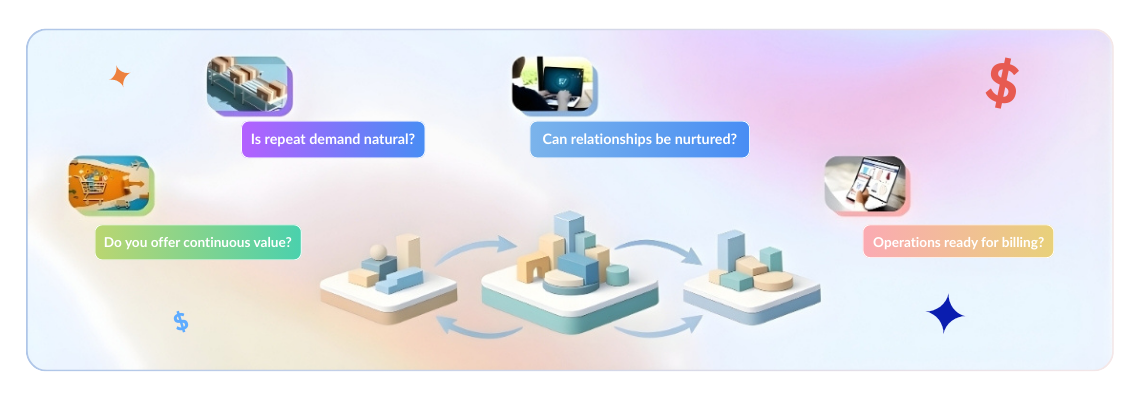
- Does your product/service offer continuous value?
- Yes: If your offering inherently provides ongoing utility, access to new content, regular replenishment, or continuous support, it's a strong candidate. Think software updates, fresh coffee beans, or continuous streaming.
- No: If it's a one-time purchase with no natural recurring need or an experience that doesn't benefit from continuous access (e.g., a wedding planner, a custom-built house), forcing a subscription might feel artificial to customers.
- Is There a natural recurrence or replenishment need?
- Yes: If customers regularly need to repurchase, re-access, or receive updates, a subscription can simplify their lives and streamline your business.
- No: If the product has a very long lifecycle (e.g., a refrigerator) or the service is truly a one-off, a subscription will be a hard sell unless you can pivot the value proposition (e.g., maintenance plan for the refrigerator).
- Can you cultivate strong customer relationships?
- Yes: The subscription model thrives on loyalty and engagement. If your business is passionate about customer service, feedback, and building a community, you have a natural advantage.
- No: If your business is purely transactional, resistant to feedback, or struggles with customer support, a subscription model will highlight these weaknesses and lead to high churn.
- Are you prepared for a long-term focus?
- Yes: Subscription businesses require patience. Initial profitability might be lower as you invest in acquisition and retention. The payoff comes from long-term CLV.
- No: If your business needs immediate, large-scale profits from individual sales, the slower, compounding nature of recurring revenue might be frustrating.
- Can you adapt and innovate continuously?
- Yes: Subscribers expect ongoing value and improvement. If your team is geared for continuous product development, content updates, and service enhancements, you'll thrive.
- No: If your product or service is static and rarely updated, subscribers will eventually get bored or feel they're no longer getting their money's worth.
- Do you have the operational capacity for recurring billing and support?
- Yes: Are you ready to invest in subscription management software, dedicated customer support, and scalable infrastructure (for delivery or digital access)?
- No: Attempting a subscription model without the proper backend tools and processes will lead to administrative chaos and frustrated customers.
If you find yourself nodding "yes" to most of these considerations, then the subscription model likely holds significant potential for your business. It demands a shift in mindset—from selling products to fostering relationships, from transactions to continuous value delivery. But for those who embrace its principles, the rewards of predictable revenue, deeper customer insights, and sustainable growth can be truly transformative. The subscription economy is here to stay, and understanding its mechanics is a vital step for any entrepreneur or business leader looking to build for the future.