
Welcome, future subscription entrepreneur! You're standing at the edge of one of the most exciting and rewarding business landscapes of our time. The idea of starting your own subscription business might feel a little daunting right now, a vast ocean of possibilities stretching before you. But fear not, Recurpay is here to be your seasoned captain, guiding you through the practical realities of building and sustaining a subscription model. By the end of this journey, you'll have a clear, actionable roadmap to transform your brilliant idea into a thriving, recurring revenue machine.
The subscription economy: Why now is the time to launch
Think about your daily life. What do you subscribe to? Netflix? Spotify? That fancy coffee delivery service? A meal kit? Even the software you use for work likely operates on a subscription model. We're living in an era where access often trumps ownership, and convenience is king. This isn't just a trend; it's a fundamental shift in consumer behavior that creates an incredible opportunity for savvy entrepreneurs like you.
Understanding the power of recurring revenue
Imagine for a moment: instead of constantly chasing new customers for one-off sales, you have a predictable stream of income flowing into your business each month. That, my friend, is the magic of recurring revenue. It's like having a steady river instead of relying on seasonal rainfall. This predictability allows for better forecasting, smarter investments, and a deeper relationship with your customers.
Let's illustrate this with a simple comparison:
Consider a traditional retail store selling a single item. Every day, they start at zero, needing to make new sales to keep the lights on. Now, picture a subscription box business. After the initial sign-up, a customer generates revenue month after month without additional marketing effort for acquisition. This compounding effect means that your revenue base grows steadily, providing stability and allowing you to focus on refining your product and delighting your existing subscribers. It reduces the stress of constant acquisition and allows for more sustainable growth.
Identifying your niche: Beyond the buzzwords
The subscription economy is booming, and that means competition. Simply saying "I want to start a subscription box" isn't enough. You need to dig deeper, beyond the initial buzzwords, to find a niche that is both underserved and sustainable.
Think of it like this: the entire market is a massive pie. Instead of trying to grab a tiny slice of the main course, you're looking for a delightful, overlooked dessert that no one else has noticed yet. Perhaps it's a specific dietary need, a hyper-focused hobby, or a unique lifestyle choice. For example, instead of "coffee subscription," consider "ethically sourced, single-origin coffee for cold brew enthusiasts." Or instead of "beauty box," think "cruelty-free, vegan skincare samples for busy professionals." The narrower your focus, the easier it is to stand out and connect with your ideal customer. Don't be afraid to be specific; specificity is your superpower here.
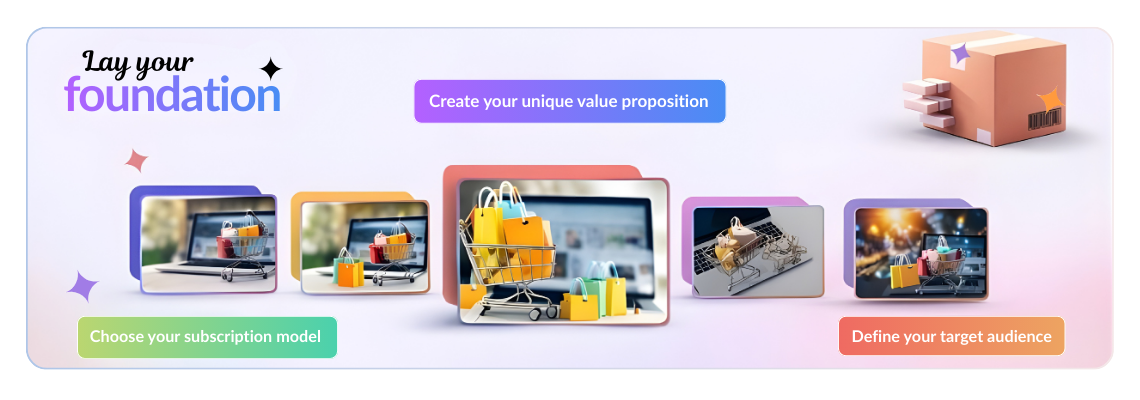
Phase 1: Laying the foundation – Your big idea
Every magnificent building starts with a solid foundation. In business, that foundation is your big idea, meticulously planned and thoughtfully constructed. This isn't just about dreaming; it's about strategic thinking.
Step 1: Unearthing your unique value proposition
This is where you answer the fundamental question: Why should someone subscribe to *your business instead of all the other options out there?* Your Unique Value Proposition (UVP) is the core promise you make to your customers. It's not just what you offer, but the specific benefit you provide that no one else can or does as well.
Let's say you're passionate about sustainable living. Many companies offer eco-friendly products. But perhaps your UVP isn't just "eco-friendly products." Maybe it's "effortless sustainable living delivered to your door, curated specifically for urban dwellers with limited time, ensuring every product is 100% plastic-free and carbon-neutral." See the difference? It's precise, compelling, and addresses a specific pain point (limited time, urban living) with a clear solution (effortless, curated, 100% plastic-free).
To unearth your UVP, ask yourself:
- What problem am I solving for my customers?
- What unique expertise or passion do I bring to the table?
- How am I different from existing solutions?
- What emotional benefit does my offering provide? (e.g., convenience, discovery, self-care, expertise)
Don't rush this step. Your UVP will be the guiding star for all your marketing and product development efforts.
Step 2: Defining your target audience with laser focus
Who are you trying to serve? This isn't a vague group of "everyone who drinks coffee." This is a specific, detailed persona that you can almost picture sitting across from you. The more precisely you understand your target audience, the better you can tailor your product, messaging, and marketing efforts.
Think of it like this: if you're throwing a party, you don't just invite "people." You invite friends who share your interests, who will enjoy the music, and who will appreciate the food. Your business is a party, and your target audience are your ideal guests.
Consider creating a detailed customer avatar. Give them a name, an age range, a profession, hobbies, interests, and most importantly, their pain points and aspirations. What are their daily struggles? What do they dream about? What values do they hold dear?
For our cold brew enthusiast example, perhaps their avatar is "Liam, 32, a busy software engineer living in Seattle. He loves good coffee but doesn't have time for elaborate brewing rituals. He values quality, ethically sourced products, and wants to discover new, interesting roasts without the hassle of research. He’s willing to pay a premium for convenience and excellent taste." Now, imagine trying to market to Liam versus just "coffee drinkers." Which approach feels more effective?
Step 3: Choosing your subscription model
This is where the mechanics of your recurring revenue come into play. There are several popular subscription models, each with its own strengths.
- Curation/Discovery boxes: This is the most common model, where customers receive a curated selection of products regularly. Think Birchbox (beauty samples), FabFitFun (lifestyle products), or BarkBox (dog toys and treats). The value here is discovery, convenience, and often a sense of surprise.
- Replenishment subscriptions: This model focuses on products that customers use regularly and need to restock. Examples include Dollar Shave Club (razors), Chewy (pet food), or Native (deodorant). The value is convenience and ensuring customers never run out of essential items.
- Access subscriptions: Here, customers pay for ongoing access to a service, content, or community. Think Netflix (streaming video), Spotify (music), or Headspace (meditation app). The value is continuous access to something they desire.
- Service subscriptions: This model involves recurring services, like a monthly car wash membership, a virtual assistant service, or a lawn care service. The value is convenience and offloading tasks.
When choosing, consider your product, your UVP, and what resonates most with your target audience. Does your product lend itself to discovery? Is it something people constantly need to replenish? Are you offering ongoing access to a valuable resource or service? Don't feel limited to one model; some businesses successfully combine elements of different models. For instance, a coffee subscription might offer both curated discovery boxes and replenishment of favorite blends.
Phase 2: Building your business – From concept to creation
With your foundation firmly in place, it's time to roll up your sleeves and start building. This phase is about transforming your carefully crafted ideas into tangible reality.
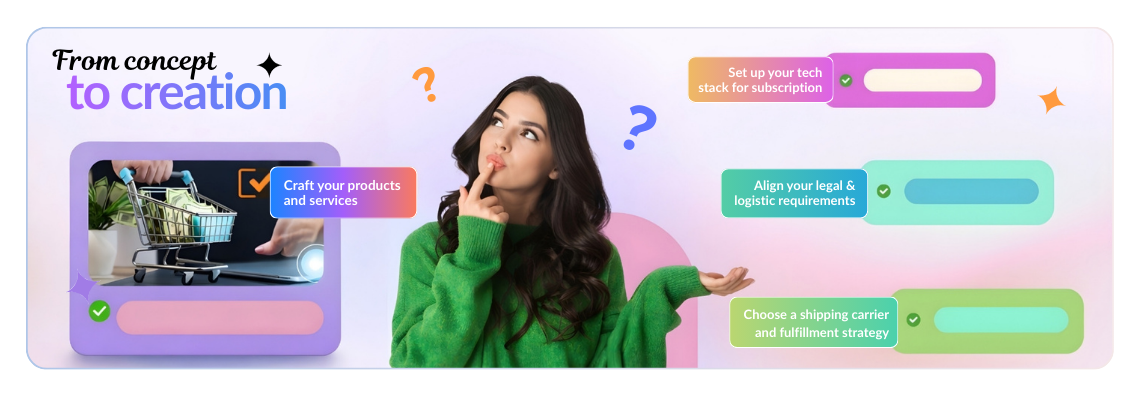
Step 4: Crafting your product or service offering
This is the heart of your business – what you actually deliver to your customers. Your offering needs to consistently exceed expectations and reinforce your UVP.
If you're selling physical products, this involves:
- Sourcing: Finding reliable suppliers who can meet your quality standards and provide products at a sustainable cost. Consider bulk pricing, minimum order quantities (MOQs), and lead times. If you're curating, building relationships with smaller, artisanal brands can be a significant differentiator.
- Packaging: This is crucial for subscription boxes. Your packaging is part of the customer experience. It should be visually appealing, protective, and reflect your brand's personality. Unboxing videos are a testament to how important this step is. Think about sustainable packaging options if that aligns with your brand values.
- Inventory Management: How will you store your products? How will you track what you have? Will you fulfill orders yourself or use a third-party logistics (3PL) provider? Start small and scale as you grow.
If you're offering a digital service or content:
- Content Creation: Develop high-quality, engaging content that consistently delivers value. This could be videos, articles, interactive tools, or guided programs.
- Platform Development: Build or choose a platform that can host your content or service, ensure smooth delivery, and provide a seamless user experience. Usability is paramount here.
No matter your offering, quality is non-negotiable. One bad experience can lead to churn, so invest in delivering excellence from day one. And remember, consistency is key in the subscription world. Your customers expect a certain level of quality and value with each delivery or access period.
Step 5: Setting up your tech stack
Your "tech stack" is the collection of tools and platforms that will power your subscription business. Think of it as the engine and navigation system for your entrepreneurial vehicle. Choosing the right tools will automate processes, manage subscriptions, and provide valuable insights.
Here are the essential components:
- E-commerce platform with subscription capabilities: This is your storefront and your subscription manager. Popular options include:
- Shopify: Extremely popular, user-friendly, and has a vast app ecosystem. You'll need a dedicated subscription app (like Recharge, Bold Subscriptions, or Appstle) to add recurring billing functionality. This is a great starting point for most physical product businesses.
- WooCommerce (for WordPress): A flexible, open-source option if you're comfortable with WordPress. Similar to Shopify, you'll need a subscription plugin.
- Purpose-built subscription platforms (e.g., Cratejoy, Subbly): These platforms are designed specifically for subscription box businesses, offering integrated features for product management, recurring billing, and shipping. They can be great for simpler operations but might offer less customization than Shopify.
- Shopify: Extremely popular, user-friendly, and has a vast app ecosystem. You'll need a dedicated subscription app (like Recharge, Bold Subscriptions, or Appstle) to add recurring billing functionality. This is a great starting point for most physical product businesses.
- Payment gateway: This allows you to process credit card payments securely. Most e-commerce platforms integrate seamlessly with popular gateways like Stripe, PayPal, or Braintree. Ensure it supports recurring billing.
- Email marketing platform: Essential for communicating with your subscribers, sending order confirmations, shipping updates, marketing promotions, and win-back campaigns. Tools like Mailchimp, Klaviyo, or ActiveCampaign are excellent choices.
- Customer relationship management (CRM): As you grow, tracking customer interactions, preferences, and feedback becomes vital. Many email marketing platforms offer basic CRM features, but dedicated CRMs like HubSpot (free tier available) or Zoho CRM can be invaluable.
- Analytics tools: Google Analytics is a must-have for understanding website traffic. Your e-commerce platform and subscription app will also provide key metrics like churn rate, average revenue per user (ARPU), and customer lifetime value (CLTV).
Don't overcomplicate this initially. Start with the essentials and scale your tech stack as your business evolves. The goal is efficiency and a seamless customer experience, not a collection of every shiny new tool.
Step 6: Legal and logistics: Dotting your I's and crossing your T's
This might not be the most exciting part, but it's absolutely critical. Skipping these steps can lead to significant headaches down the road.
- Business registration:
- Choose a business structure: Will you be a sole proprietorship, LLC, S-Corp, or C-Corp? Consult with an attorney or accountant to determine the best structure for your situation, considering liability and tax implications.
- Register your business name: Ensure your chosen name is available and register it with the appropriate state and local authorities.
- Obtain necessary licenses and permits: Depending on your product and location, you might need specific licenses (e.g., food handling permits, reseller permits).
- Employer identification number (EIN): If you plan to hire employees or establish an LLC/corporation, you'll need an EIN from the IRS.
- Choose a business structure: Will you be a sole proprietorship, LLC, S-Corp, or C-Corp? Consult with an attorney or accountant to determine the best structure for your situation, considering liability and tax implications.
- Terms & conditions and privacy policy:
- Transparent policies: These are non-negotiable for any online business, especially subscriptions. Clearly outline your billing cycles, cancellation policy, refund policy, shipping timelines, and how you handle customer data.
- Legal compliance: Ensure your policies comply with relevant consumer protection laws (e.g., GDPR, CCPA). It's highly recommended to have a legal professional draft or review these documents.
- Transparent policies: These are non-negotiable for any online business, especially subscriptions. Clearly outline your billing cycles, cancellation policy, refund policy, shipping timelines, and how you handle customer data.
- Shipping and fulfillment:
- Choose a shipping carrier: Research options like USPS, UPS, FedEx, or DHL. Compare rates, tracking capabilities, and reliability for your typical package sizes and destinations.
- Packaging and labeling: Invest in good quality, branded packaging. Ensure your labels are accurate and compliant with carrier requirements.
- Fulfillment strategy: Will you pack and ship orders yourself (self-fulfillment) or outsource it to a 3PL?
- Self-fulfillment: Good for starting small, offers direct control, but can become time-consuming as you scale.
- 3PL (Third-party logistics): They store your inventory, pack your boxes, and ship them out. This frees up your time but involves additional costs. Research providers carefully, focusing on those experienced with subscription boxes.
- Self-fulfillment: Good for starting small, offers direct control, but can become time-consuming as you scale.
- Choose a shipping carrier: Research options like USPS, UPS, FedEx, or DHL. Compare rates, tracking capabilities, and reliability for your typical package sizes and destinations.
- Insurance: Protect your business from unforeseen events. General liability insurance is a good starting point, and product liability insurance is essential if you're selling physical goods.
Taking the time to set up these legal and logistical frameworks properly will provide a stable foundation for your subscription business to grow.
Phase 3: Launching and growing – Beyond the first sale
You've built your offering, set up your systems, and dotted your legal i's. Now, it's time for the moment of truth: introducing your creation to the world. But launch isn't the finish line; it's the starting gun for a continuous race of growth and adaptation.
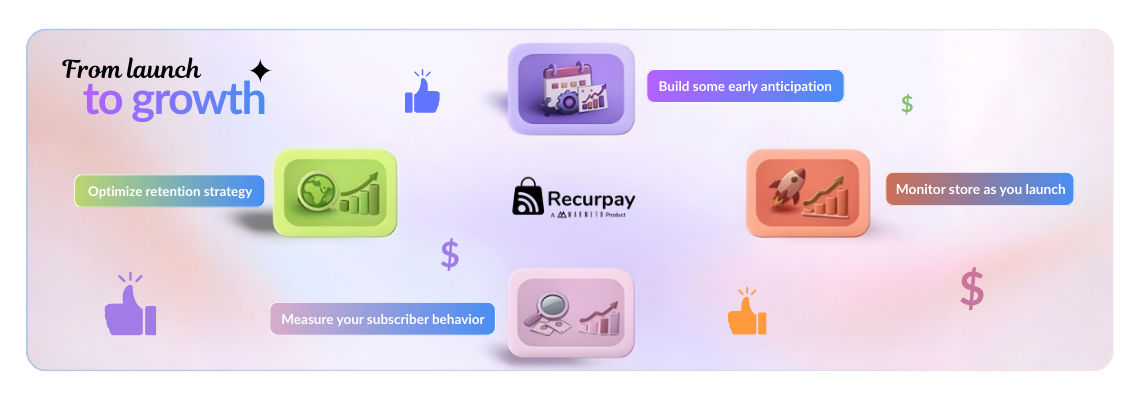
Step 7: Pre-launch hype: Building anticipation
Don't wait until launch day to tell people about your business. Start building excitement before you open your virtual doors. This is about creating a buzz and a sense of urgency.
Imagine a highly anticipated movie. You see trailers months in advance, interviews with the cast, and behind-the-scenes glimpses. Your subscription business deserves the same kind of build-up.
Here's how to generate pre-launch hype:
- Landing page with email capture: Create a simple landing page that clearly explains what your subscription is, its unique value, and when it will launch. Offer an incentive for early sign-ups – maybe a discount on the first box, an exclusive item, or early access. This builds your initial email list, which is gold.
- Social media sneak peeks: Start sharing tantalizing glimpses of your products, your packaging, or your process on platforms where your target audience hangs out. Use compelling visuals and engaging captions. Run polls, ask questions, and encourage interaction.
- Influencer outreach: If your budget allows, identify micro-influencers in your niche who align with your brand. Offer them a free preview in exchange for honest reviews or posts leading up to your launch.
- Content marketing: Write blog posts or create videos that address the pain points your subscription solves. Position yourself as an expert and build trust. For example, if you're launching a healthy snack box, write about the challenges of healthy eating on the go.
- Referral programs (Pre-Launch): Encourage those who sign up for your email list to refer friends, offering extra perks for successful referrals.
The goal here is to arrive at launch day with a hungry audience, ready to subscribe.
Step 8: Your grand launch: Making a splash
Launch day is a culmination of all your hard work. It's time to open your doors wide and welcome your first subscribers. This needs to be a coordinated effort to maximize impact.
- Email campaign: Send a series of emails to your pre-launch list. Announce that subscriptions are open, reiterate your UVP, and clearly link to your sign-up page. Create a sense of urgency (e.g., "limited spots available," "launch day discount ends soon").
- Social media blitz: Post across all your active channels, encouraging sign-ups. Consider running targeted ads to reach a wider audience that matches your customer avatar.
- Press release (if applicable): If your product is truly innovative or has a compelling story, consider sending a press release to relevant industry publications or local news outlets.
- Launch day promotions: Offer a special incentive for early subscribers. This could be a deeper discount, an extra item in their first box, or a limited-edition bonus.
- Engage with early subscribers: Respond quickly to questions, thank them personally, and make them feel like valued members of your community. Their initial experience will shape their perception of your brand.
Think of launch day as a marathon, not a sprint. It's the beginning of your sales journey, not the end. Be prepared to monitor your website, social media, and email for immediate feedback and be ready to troubleshoot any technical glitches quickly.
Step 9: Analyzing and adapting: The cycle of growth
The launch is over, but the work isn't. In the subscription world, the real growth happens after the initial sale. This is a continuous cycle of analysis, learning, and adaptation.
Key metrics to monitor:
- Churn rate: This is the percentage of subscribers who cancel within a given period. A high churn rate is a red flag. Aim to keep it as low as possible.
- Customer lifetime value (CLTV): The total revenue you expect to generate from a single customer over their entire subscription period. This helps you understand how much you can afford to spend on customer acquisition.
- Customer acquisition cost (CAC): How much it costs you to acquire a new subscriber. Compare this to your CLTV. Ideally, CLTV should be significantly higher than CAC.
- Average revenue per user (ARPU): The average amount of revenue you generate per subscriber in a given period.
- Engagement metrics: For content or service subscriptions, track how often users log in, how long they stay, and which features they use most. For product boxes, track feedback on items.
Strategies for Adaptation and Growth:
- Gather feedback relentlessly: Send surveys, monitor social media comments, and actively solicit reviews. Understand what your subscribers love and what they wish was different. This feedback is invaluable for product improvement.
- Optimize the customer journey: From sign-up to delivery to cancellation, map out your customer's journey and look for friction points. Can you make onboarding smoother? Is your cancellation process clear but also offers options to pause or switch plans?
- Product/service evolution: Use feedback and market trends to constantly improve your offering. Introduce new variations, upgrade features, or refine your curation based on subscriber preferences.
- Retention strategies:
- Excellent customer service: This is paramount. Prompt, helpful, and friendly support can turn a frustrated customer into a loyal advocate.
- Loyalty programs: Reward long-term subscribers with exclusive perks, discounts, or bonus items.
- Personalization: As you gather data, personalize offerings or communications where possible.
- Win-back campaigns: For those who churn, have an automated email sequence that attempts to bring them back, perhaps with a special offer or by highlighting new improvements.
- Excellent customer service: This is paramount. Prompt, helpful, and friendly support can turn a frustrated customer into a loyal advocate.
- Marketing and acquisition: Continue to experiment with different marketing channels. Refine your ads, explore partnerships, and leverage word-of-mouth through referral programs.
The subscription business thrives on relationships. The more you understand, engage with, and delight your subscribers, the more sustainable and successful your business will become.
The road ahead: Embracing the journey of a subscription entrepreneur
You've now got a comprehensive roadmap for starting your subscription business. From unearthing your unique idea and meticulously planning your offering, to building your tech stack and launching with a bang, and finally, to the ongoing cycle of analysis and adaptation – each step is crucial.
Remember, entrepreneurship is a journey, not a destination. There will be triumphs and challenges, moments of exhilarating success, and times where you'll need to pivot and learn. The subscription model offers an incredible advantage: a direct, ongoing relationship with your customers. Embrace this connection, listen intently to their needs, and consistently strive to deliver exceptional value.
The world is hungry for convenience, discovery, and curated experiences. With passion, perseverance, and this guide in hand, you are well-equipped to build a thriving subscription business that not only generates recurring revenue but also genuinely delights its community. Now, go forth and build something amazing!