


how to increase subscriber lifetime value on Shopify | Updated September 2026 | Recurpay Editorial Team | 3–6 hours to implement across steps | Beginner
What You'll Learn
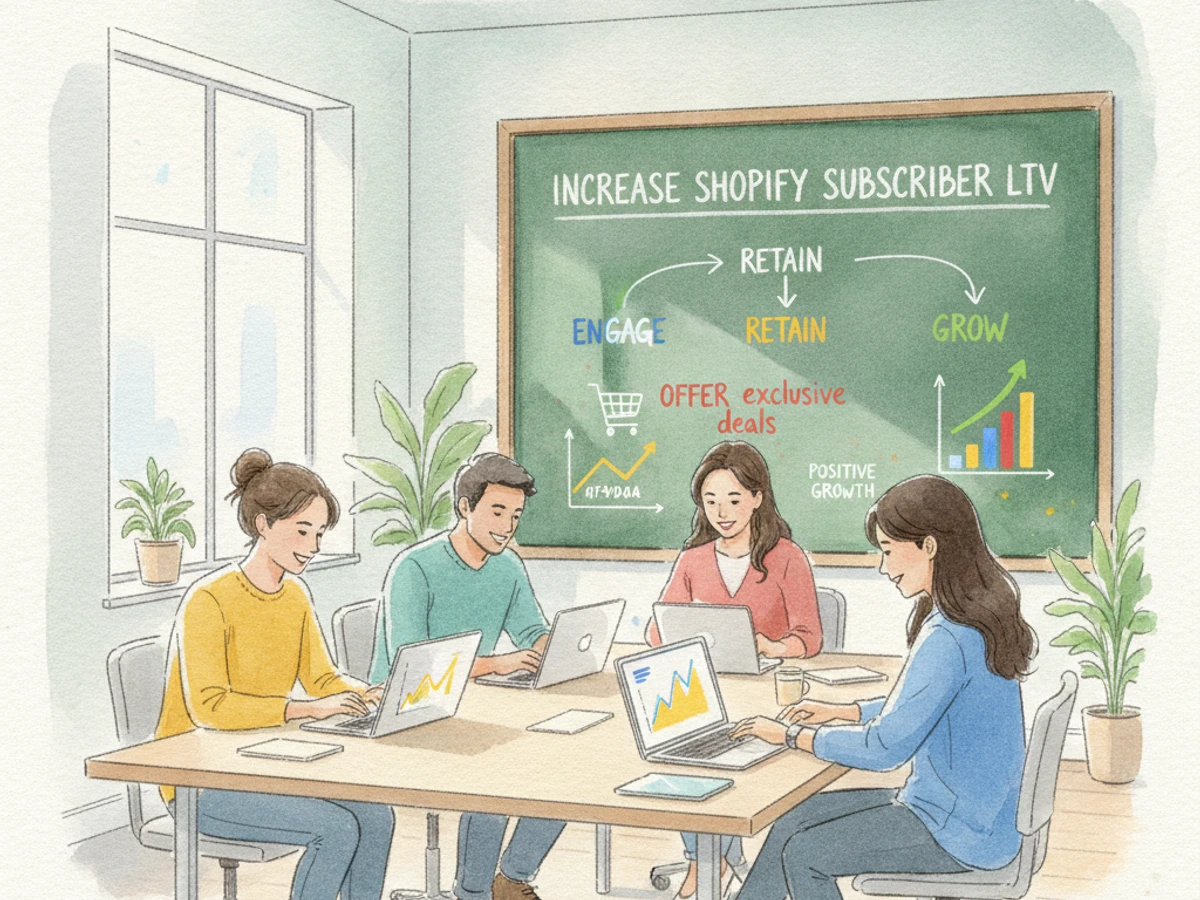
If you run a Shopify store with subscriptions, you already know that recurring revenue feels different from one-time sales. It's steadier, more predictable, and far more valuable. But knowing that and actually maximizing it are two different things. The answer to how to increase subscriber lifetime value on Shopify comes down to five compounding levers: structured subscription pricing, flexible subscriber controls, targeted upsells, smart dunning, and a cancel-intervention flow. Execute all five, and the math changes dramatically. Subscription LTV, or Lifetime Value, typically runs 3–5x higher than one-time DTC at the same gross margin — meaning a well-retained subscriber is your single most valuable revenue asset. This guide walks through each lever step by step, with concrete examples, benchmarks, and the specific tools that connect strategy to execution.
- Design a subscription pricing structure that converts browsers and retains buyers long-term.
- Give subscribers the flexibility controls that prevent unnecessary cancellations.
- Add upsells and product swaps that raise average order value without adding friction.
- Recover failed payments automatically before they become permanent churn.
- Intercept cancellations with a reason-matched flow that saves 15–40% of at-risk revenue.
Prerequisites: An active Shopify store, at least one recurring product or replenishable SKU, and a Shopify subscription app installed (setup takes under 30 minutes with a tool like Recurpay).
Why Subscriber Lifetime Value Matters in 2026
Subscriptions are no longer a niche play. In 2026, 58% of DTC brands on Shopify offer subscriptions, and the global subscription commerce market has hit $330 billion. Yet most Shopify merchants still pour money into acquisition while letting retention happen by accident — and that's an expensive mistake. Average ecommerce customer acquisition cost rose 40 to 60% between 2023 and 2025, and 88% of subscription brands reported higher acquisition costs in 2025. When every new customer costs more to reach, every additional month a subscriber stays active becomes materially more valuable.
The math is straightforward and worth repeating: subscription DTC lifetime value runs 3 to 5x higher than one-time purchases at the same gross margin, driven by purchase frequency. Subscribers average 8 to 18 orders versus 1 to 1.5 for one-time buyers. The compounding effect is steep too — a 2% churn reduction doubles average subscriber LTV. For most Shopify brands, that single insight should reorder every growth priority. It's not about chasing more traffic. It's about keeping the customers you already have.
For Shopify merchants in 2026, CLV (Customer Lifetime Value) matters more than ever because paid acquisition is expensive, margins are tighter, and a store with stronger repeat purchase behavior can outgrow a store with more traffic but weaker retention. The five steps below address the controllable levers that move this number.
Key Takeaway: In an era of rising acquisition costs, focusing on subscriber retention and increasing LTV is the most impactful strategy for sustainable growth on Shopify, with even small reductions in churn leading to significant LTV increases. For supporting data, see What Is Customer Lifetime Value? How to Calculate CLV.
The Process at a Glance
| Step | Action | Time | Outcome |
|---|---|---|---|
| 1 | Build a tiered subscription pricing structure | 1–2 hours | Higher conversion and annual plan adoption |
| 2 | Enable flexible subscriber self-service controls | 30–60 minutes | Fewer voluntary cancellations from friction |
| 3 | Add subscription-aware upsells and product swaps | 1–2 hours | 10–30% increase in average order value |
| 4 | Activate smart dunning for failed payments | 30–60 minutes | Recover 20–35% of involuntary churn revenue |
| 5 | Deploy a reason-matched cancellation flow | 1–2 hours | Save 15–40% of subscribers who click cancel |
Total estimated implementation time: 3–6 hours across all steps. Most stores see measurable LTV improvement within the first 30–60 days once all five layers are active.
Step 1: Build a Tiered Subscription Pricing Structure
What You're Doing
Your pricing is the first signal you send to subscribers — and it shapes everything that follows. A well-designed pricing structure converts new customers efficiently while maximizing how long they stay, not just what they pay on day one.
How to Do It
- Set a subscribe-and-save discount of 10–15%. The optimal subscribe-and-save discount is 10–15% — enough to make the recurring option the rational choice, without giving away margin unnecessarily. Go below 10% and the value prop weakens. Go above 20% and you're eroding margin without proportional retention benefit.
- Create a maximum of three pricing tiers. Offer 3 pricing tiers max. More than three creates decision paralysis; fewer than two leaves AOV (Average Order Value) upside on the table. A "monthly / quarterly / annual" structure works for most replenishable categories.
- Prioritize an annual billing option. Annual billing cuts churn by 2–3x. Price the annual plan at a discount that converts — roughly equivalent to getting one or two months free — and surface it prominently on the product page toggle. Make it visually hard to miss.
- Communicate value, not just price. When messaging your plans, lead with outcome ("never run out," "delivered automatically") rather than discount percentage. This positions the subscription as a convenience, not a deal.
Example: Tiered Structure for a Supplements Brand
| Plan | Billing Frequency | Discount vs. One-Time | Primary Retention Lever |
|---|---|---|---|
| Starter | Monthly | 10% off | Low commitment, easy to start |
| Preferred | Quarterly | 15% off | Longer cycle reduces churn windows |
| Annual | Yearly (prepaid) | 20% off | Locks in LTV, near-zero churn risk |
Best Practices
- Place the annual plan in the visual "anchor" position (center column of a three-column layout) to leverage pricing psychology.
- If raising prices for existing subscribers, grandfather the old price, give 30–60 days' notice, and offer an annual lock-in. Subscribers accept increases of 5–8% per year with clear notice.
What Done Looks Like
Your product page shows a clear monthly/annual toggle with visible savings stated in dollar terms, and at least 15% of new subscribers are choosing the annual option within the first 30 days.
Key Takeaway: A well-structured pricing model with a 10–15% subscribe-and-save discount and a prominent annual billing option (cutting churn by 2–3x) is fundamental for converting browsers and maximizing long-term subscriber value. For a more detailed walkthrough, see Shopify Subscription Pricing Strategy Guide for 2026.
Step 2: Enable Flexible Subscriber Self-Service Controls
What You're Doing
Here's a counterintuitive truth: making it easy for subscribers to change their plans often saves more revenue than making it hard to leave. When you give subscribers a frictionless way to pause, skip, or adjust, they choose flexibility over cancellation.
How to Do It
- Turn on pause and skip functionality. Pause usage rises by 337% when offered, according to Recurly's 2026 State of Subscriptions, preventing over 400,000 cancellations. A subscriber who can pause for six weeks rarely cancels outright.
- Enable product swap within the portal. Allowing subscribers to easily swap products can expose them to other items they'll love — and give them more reasons to keep buying from you in the future. Swap access also resolves overstock objections without a cancellation.
- Allow frequency adjustments. Let subscribers shift from monthly to every-six-weeks without contacting support. This addresses the most common "too much product" churn reason without requiring a human touchpoint.
- Make the portal easy to find. Include a direct "Manage Subscription" link in every order confirmation and shipping email. Friction in finding the portal pushes subscribers toward cancellation as the default action.
Best Practices
- According to Chargebee's 2025 consumer research, 78% of consumers demand pause or swap options from their subscriptions, and 82% are more likely to subscribe when cancellation is easy. Ease of exit is a trust signal, not a risk.
- Surface the portal in post-purchase SMS as well as email — shorter click path means higher self-service adoption.
What Done Looks Like
Your subscriber portal shows active usage of skip and pause features, with voluntary cancellation rate declining as a percentage of total active subscribers month-over-month.
Key Takeaway: Offering flexible self-service options like pause, skip, and product swaps is crucial for subscriber retention, as it empowers customers to manage their subscriptions and significantly reduces voluntary churn.
Step 3: Add Subscription-Aware Upsells and Product Swaps
What You're Doing
You've acquired the subscriber. Now it's time to increase the revenue generated per subscriber per order — raising average order value (AOV) without acquiring a single new customer. This is where leverage lives.
How to Do It
- Offer a one-time add-on at the pre-shipment notification. The 3–5 days before a subscription order processes is the highest-intent window for an add-on offer. A single relevant product recommendation here is non-intrusive and high-converting.
- Use subscription-aware filtering for recommendations. Generic recommendation engines pitch products the subscriber already receives. Filter by current line items and purchase history to surface only genuinely complementary items. Subscription-aware filtering (eligibility, current line items, frequency) can lift attach rates from 2–3% to 15–20%.
- Present tiered upgrade options in the subscriber portal. A subscriber on a 30-count monthly plan should see a 60-count option with the implied per-unit saving clearly shown. This single upsell path compounds over every future billing cycle.
- Bundle complementary products at a subscriber-exclusive price. Stores with strategic bundling see AOV increases of 15–30%. Upselling and cross-selling can boost AOV by 10–30% when done correctly.
Example: Pre-Shipment Upsell for a Coffee Subscription
| Trigger | Offer | Expected Attach Rate | AOV Lift |
|---|---|---|---|
| 3 days before billing | Add a bag of seasonal roast (one-time) | 8–15% | +$14–$18 per order |
| Subscriber portal visit | Upgrade from 250g to 500g bag | 5–10% | +$10–$12 recurring |
| Second renewal | Add a coffee grinder at 15% off | 3–6% | +$20–$30 one-time |
Common Mistakes
- Presenting upsells at checkout for cold subscribers. New subscribers are already committing to a recurring payment — adding friction at checkout increases abandonment. Save upsells for post-signup and pre-shipment moments.
- Making the same offer every cycle. Rotate offers based on season, product launches, and subscriber tenure to maintain engagement without desensitizing your audience.
What Done Looks Like
Average subscription order value is measurably higher than it was at launch, with at least one upsell or add-on generating recurring or repeat revenue across your subscriber base.
Key Takeaway: Implementing subscription-aware upsells and strategic bundling, particularly at pre-shipment and within the subscriber portal, can significantly increase AOV and overall subscriber revenue without new customer acquisition.
Step 4: Activate Smart Dunning for Failed Payments
What You're Doing
This is the step that most Shopify brands skip — and it costs them thousands every month. Failed subscription payments silently disappear from your revenue, and most of them are recoverable. You just need to ask.
How to Do It
- Understand the scale of the problem first. Failed payments cause 20–35% of involuntary churn among subscription businesses. These are subscribers who did not choose to leave — their payment simply failed.
- Implement smart retry logic, not a fixed schedule. Dunning management is the automated process of recovering failed subscription payments through intelligent payment retries and customer-facing notifications. When a recurring charge fails, dunning sends reminders, retries the payment at smart intervals, and gives the customer a simple way to fix the issue — all without manual work.
- Separate soft from hard declines. Soft declines occur when the issuing bank temporarily refuses the transaction — these can be recovered by retrying. Hard declines occur when the bank permanently refuses due to an invalid card, expiration, or closed account — these require a new card. Smart dunning routes each decline type to the appropriate recovery workflow.
- Send pre-expiry card alerts. Notify the customer 3–5 days before their credit card expires so the payment never fails in the first place. Prevention is more effective than recovery.
- Make card updates one-click via email or SMS. Provide a single-click payment update button via SMS or email, rather than a portal requiring mandatory sign-in. Every login barrier reduces recovery rate.
Best Practices
- The strongest Shopify subscription brands treat both failed payment recovery and cancellation management as a unified retention system rather than isolated workflows.
- Tools like Recurpay include smart dunning as a built-in feature at the $9/month plan level, making it accessible to stores at any revenue stage. Recurpay believes that unlocking subscription revenue should be accessible, fast, and hassle-free for all Shopify merchants — enabling growth without technical barriers or steep costs.
What Done Looks Like
Your dunning dashboard shows active retries in progress, pre-expiry notifications sending automatically, and a measurable decline in involuntary churn rate month over month.
Key Takeaway: Activating smart dunning is essential for recovering 20–35% of involuntary churn caused by failed payments, utilizing intelligent retry logic, pre-expiry alerts, and frictionless one-click card updates.
Step 5: Deploy a Reason-Matched Cancellation Flow
What You're Doing
When a subscriber clicks "cancel," most brands either let them go or throw a generic discount at them. The brands that win do something different: they ask why, then offer a specific solution matched to that reason. This is where you save 15–40% of the revenue that would otherwise walk out the door.
How to Do It
- Start with a cancellation reason survey. Before presenting any offer, ask why the subscriber is leaving. This data is critical for matching the right save offer, and it surfaces product or pricing issues you would otherwise never see.
- Match the save offer to the declared reason. Too much product → frequency reduction or a skip. Too expensive → a one-time discount or a lower-tier swap. Pausing for a while → a pause for 4–12 weeks. Not using it → a product swap or a usage tip email.
- Limit the flow to two offers maximum. Limit this to two offers — one alternative action and one incentive. Two offers produce the best save rate (approximately 14.7%); three or more create decision fatigue and lower conversion.
- Let subscribers exit cleanly if they decline. If the subscriber declines, let them cancel with a single clear confirmation click. No second offer, no countdown timer, no guilt-based copy. A clean exit respects the subscriber and preserves the relationship for a future win-back.
- Track 90-day retention of saved subscribers. A subscriber saved today who churns in 30 days is a delay, not a save. Measure the real value of your cancel flow by retention 90 days after the save event.
Best Practices
- Well-designed cancellation flows can save 20–40% of at-risk revenue, depending on how precisely the save offers match the specific cancellation reasons. Generic discount codes significantly underperform reason-matched offers.
- Calibrate discount depth by subscriber value. Configure the incentive by reason and by subscriber, not as one blanket coupon. Newer subscribers haven't proven their value yet, while long-tenured, high-LTV subscribers are worth protecting with a richer offer.
What Done Looks Like
Your cancellation flow is showing a measurable save rate above 15%, with saved subscribers tracked in a 90-day cohort and the most common cancellation reasons informing your product and pricing roadmap.
Key Takeaway: A reason-matched cancellation flow, limited to two targeted offers, can save 20–40% of at-risk revenue by addressing specific subscriber concerns rather than offering generic discounts, while also providing valuable feedback for product and pricing strategy.
What to Do After Completing the Process
Phase 1: Measure and Baseline (Days 1–30)
Once all five steps are live, establish clean baselines: monthly churn rate (voluntary and involuntary separately), average subscription order value, dunning recovery rate, and cancel-flow save rate. Track activation, first renewal, second renewal, active duration, contribution per shipment, and exit reason. You cannot improve what you have not measured.
Phase 2: Optimize the Weakest Lever (Days 31–90)
Review your cohort data after 60 days and identify which lever has the largest gap between current performance and benchmark. The best CLV strategy for Shopify merchants is to combine cohort analysis, stronger post-purchase flows, better segmentation, AOV optimization, and loyalty or referral programs. If dunning recovery is below 30%, audit your retry timing. If save rate is below 10%, audit your reason-to-offer matching logic.
Phase 3: Layer in Loyalty and Win-Back (Days 91–180)
Once churn is stable below 7% monthly, add a loyalty reward layer tied to subscription milestones (e.g., a free gift at order 6) and a win-back sequence for churned subscribers. Focusing on customer retention through loyalty programs and post-purchase engagement can increase profits by up to 95%, as repeat customers spend 31% more per transaction. These advanced tactics compound on top of the foundation you have already built.
Key Takeaway: After implementing the core LTV levers, continuous measurement and optimization based on cohort data are crucial, followed by layering in advanced strategies like loyalty programs and win-back campaigns to further compound retention and profitability.
Resources You'll Need
| Resource | Role in This Process | Required / Recommended / Optional | Price |
|---|---|---|---|
| Recurpay | Shopify subscription management: recurring billing, smart dunning, tiered discounts, subscriber portal, analytics | Required | $9/month | Rating: 5/5 |
| Shopify Analytics | Baseline LTV, repeat purchase rate, and cohort reporting | Required | Included with Shopify plan |
| Klaviyo | Post-purchase email and SMS flows, dunning notification sequences, win-back campaigns | Recommended | Free up to 500 contacts; paid from $20/month |
| Smile.io | Loyalty points and rewards program tied to subscription milestones | Optional | Free plan available; paid from $49/month |
Get your Shopify store subscription-ready in minutes with Recurpay's simple yet powerful platform. Enjoy seamless integration, easy migration, partner opportunities, and robust analytics to track growth. Scale your recurring revenue with no unnecessary complexity or hidden fees — Recurpay is the smart choice for modern ecommerce subscription management. See also, see How To Calculate Shopify LTV (Customer Lifetime Value)?. For related guidance, see How Skintique Migrated From Seal To Recurpay And Boosted Subscription Revenue With White Glove Migration.
Join 7,500+ brands using Recurpay
Recurpay is the answer to your customer retention game in the emerging era of subscriptions.
Get StartedTroubleshooting Common Issues
High involuntary churn despite dunning being active
Likely cause: Your retry logic is using a fixed schedule rather than intelligent timing, or your payment-update email sends subscribers to a login-walled portal page.
Fix: The most common mistake is friction. If the recovery email sends the customer into a login loop, a password reset, or a slow account page, recovery rates suffer. The best flows push the customer to a fast payment update action and get them out. Audit your recovery email click-to-resolution path and eliminate every unnecessary step.
Cancel-flow save rate below 10%
Likely cause: You are presenting a generic discount to every cancelling subscriber regardless of their stated reason.
Fix: Segment your save offers by cancellation reason. A subscriber who says "I have too much product" needs a frequency change, not a discount. The match between reason and offer is what makes the flow feel helpful rather than desperate. Map each reason to a specific action and rebuild your flow accordingly.
Upsell offers not converting in the subscriber portal
Likely cause: Recommendations are not filtered against existing subscription line items, so subscribers are being shown products they already receive.
Fix: Implement subscription-aware product filtering. Show only items that complement — not duplicate — what the subscriber already orders. Personalize by purchase history and subscription tenure for the best results.
Annual plan adoption below 10%
Likely cause: The annual plan is not visually prominent on the product page, or the savings are communicated as a percentage rather than a concrete dollar amount.
Fix: Reposition the annual plan as the default selection on the subscribe toggle, and reframe the saving in dollar terms ("Save $48/year"). Annual billing cuts churn by 2–3x, making it worth significant UX investment to improve its conversion rate. For more troubleshooting advice, see Why Your Shopify Customer Lifetime Value (CLV) Is Low— ....
Conclusion
Key Takeaways
- Outcome recap: Knowing how to increase subscriber lifetime value on Shopify comes down to five compounding levers — tiered pricing, subscriber flexibility, subscription-aware upsells, smart dunning, and a reason-matched cancel flow. Each one adds LTV independently; together they multiply it.
- Key insight: Customer lifespan equals one divided by monthly churn, so halving churn doubles LTV. Retention investment has a mathematical relationship to lifetime value that acquisition spending cannot replicate.
- Next action: Install a capable subscription management platform like Recurpay, activate smart dunning and a cancel flow within the first week, and set a 30-day baseline on voluntary and involuntary churn before layering in upsell and loyalty tactics.
FAQ
How to increase Subscriber Lifetime Value on Shopify in 2026?
The most effective approach to increasing subscriber lifetime value on Shopify in 2026 combines five proven tactics: (1) Build a tiered pricing structure with an annual billing option — annual plans cut churn by 2–3x and immediately extend predicted subscriber lifespan. (2) Enable subscriber self-service controls (pause, skip, swap, frequency change) so subscribers choose flexibility instead of cancellation. (3) Add subscription-aware upsells at pre-shipment and in the subscriber portal to raise average order value by 10–30%. (4) Activate smart dunning to recover the 20–35% of subscribers who churn due to failed payments rather than dissatisfaction. (5) Deploy a reason-matched cancellation flow that saves 15–40% of subscribers who click cancel. The How to Increase Subscriber Lifetime Value on Shopify 2026 — Step-by-Step Guide (2026) above covers each tactic with specific benchmarks, examples, and tool recommendations for US-based Shopify stores.
What is a realistic LTV benchmark for Shopify subscription stores in 2026?
Subscription-based Shopify stores see $350–$800+ LTV due to recurring revenue models, compared to an average of $168 for non-subscription stores over a three-year period. The exact number varies by category, price point, and churn rate. A 3:1 LTV-to-CAC ratio is the widely accepted minimum benchmark for a healthy subscription business; top performers reach 5:1 or higher.
What causes involuntary churn and how can Shopify brands prevent it?
Failed payments cause 20–35% of involuntary churn among subscription businesses. The root causes are expired cards, insufficient funds, and temporary bank blocks — none of which represent intentional cancellation. Prevention starts with pre-expiry card alerts sent 3–5 days before renewal. Recovery requires smart retry logic that classifies each decline as soft or hard, retries only recoverable failures, and sends a frictionless one-click payment-update link. Brands that automate this process with tools like Recurpay recover a significant portion of this otherwise silent revenue loss.
How do subscription upsells differ from standard Shopify upsells?
Standard Shopify upsells are one-time events tied to a single transaction. Subscription upsells must account for what the subscriber already receives, their billing cadence, and their tenure. A supplement subscriber who already receives a 60-count monthly bottle should not be offered the same 60-count — they should see a complementary product or a bundle upgrade. Subscription-aware filtering is the key difference: it uses current line items and purchase history to surface only genuinely additive offers, which lifts attach rates significantly compared to generic recommendation engines.
How much of a discount should a subscribe-and-save offer include?
The optimal subscribe-and-save discount is 10–15%. Below 10%, the value proposition is weak enough that many customers choose the one-time option. Above 20%, you begin eroding margin without proportional retention benefit. For annual plans, a discount equivalent to one to two free months (roughly 8–17% off the monthly rate) is the standard incentive range. Always frame the saving in dollar terms rather than percentages — concrete savings feel more tangible to prospective subscribers.
When should a cancellation flow offer a discount vs. a non-monetary alternative?
A monetary offer (discount or free gift) should only be presented when the subscriber's stated reason is price-related. For operational objections — too much product, wrong variant, temporary life change — a non-monetary alternative (frequency change, product swap, or pause) is both more appropriate and better for your margin. Offering a discount to a subscriber who is simply overstocked does not address their actual problem and trains your subscriber base to use the cancel flow as a discount mechanism. Match every offer to the declared reason, and reserve monetary incentives for price-sensitive segments.
How long does it take to see LTV improvement after implementing these steps?
Monthly recurring revenue is visible almost immediately once subscribers start billing. The full LTV impact, which depends on how long subscribers stay, takes longer to measure — typically 6 to 12 months before you have enough cohort data to see patterns. However, churn rate improvement and dunning recovery metrics are visible within the first 30–60 days, giving you early leading indicators that the strategy is working before LTV fully compounds.
Is Recurpay suitable for Shopify stores that are new to subscriptions?
Recurpay is a Shopify-native subscription management app trusted by 7,500+ brands globally to automate recurring payments, reduce churn, and grow predictable revenue. Built specifically for DTC and ecommerce merchants, Recurpay handles everything from simple monthly subscriptions to complex prepaid plans, mixed-frequency billing, and mid-cycle plan changes — all without requiring custom development or technical resources. At $9/month with a no-code setup and free white-glove migration from 25+ competitor platforms, it is one of the most accessible entry points for Shopify brands launching subscriptions for the first time.
Methodology: This guide draws on publicly available 2025–2026 industry research from sources including Recurly's 2026 State of Subscriptions, Chargebee's 2025 consumer research, Eightx DTC LTV benchmarks, and Shopify platform data. Recurpay pricing ($9/month) and rating (5/5) are based on published brand data as of September 2026. Individual results will vary based on product category, price point, existing churn rate, and implementation quality. All benchmarks cited (churn rates, save rates, LTV multipliers) reflect published industry ranges, not guaranteed outcomes. This article was produced for informational purposes and does not constitute financial or legal advice.