


Understanding the Role of a Cancellation Flow
Losing a subscriber doesn't have to be inevitable. A well-designed cancellation flow, which is the sequence of screens, prompts, and offers a user encounters when they attempt to cancel, is one of the most underutilized retention tools in a SaaS or subscription business. Yet most companies treat it as an afterthought, leaving significant revenue on the table.
The data backs this up. According to Recurly's research on cancellation flows, a thoughtfully structured cancellation experience can save a meaningful percentage of subscribers who would otherwise churn. These are customers who already said yes once, they just need the right nudge at the right moment.
A cancellation flow does more than attempt a last-minute save. It can surface options like a downgrade plan, a pause, or a personalized discount — giving subscribers an off-ramp that feels like a win rather than a dead end. Building flexible subscriber options directly into the experience is what separates high-retention brands from the rest.
The following steps will show you exactly how to build one that works.
Step 1: Analyze Your Current Subscription Churn Metrics
Before you can fix a leaky cancellation flow, you need to understand exactly where — and why — subscription churn is happening. Jumping straight into redesigning screens without baseline data is like prescribing medicine before running any tests.
Start by pulling these core metrics:
- Churn rate — the percentage of subscribers who cancel within a given time period, calculated as cancellations divided by total active subscribers. (a useful benchmark to understand)
- Cancellation reason distribution — which exit reasons appear most frequently
- Offer acceptance rate — this rate measures how often subscribers accept a retention alternative, such as a discount, pause, or plan downgrade, when it's presented during the cancellation process
- Drop-off points — where in the cancellation sequence users disengage entirely
In practice, the most actionable insight often comes from segmenting churn by user cohort. A long-tenured subscriber canceling looks very different from someone leaving after a free trial — and your flow should treat them differently.
A cancellation flow built on guesswork rarely converts; one built on real churn data does. According to RevenueCAT's cancellation flow best practices, understanding why users leave is the essential foundation for every retention tactic that follows.
With this data in hand, you're well-positioned to move into the next critical step: collecting structured, in-flow feedback that turns those exit reasons into actionable improvements.
How to Collect and Use Feedback Effectively
Now that you have a clear picture of your churn metrics, the next priority is understanding the why behind those cancellations. Raw numbers tell you what's happening — subscriber feedback tells you how to fix it.
A well-structured feedback survey embedded directly in the cancellation flow is one of the most practical tools to reduce churn over time. According to best practices from Omeda, asking subscribers why they're leaving — before they complete the cancellation — gives you actionable intelligence you simply can't gather elsewhere.
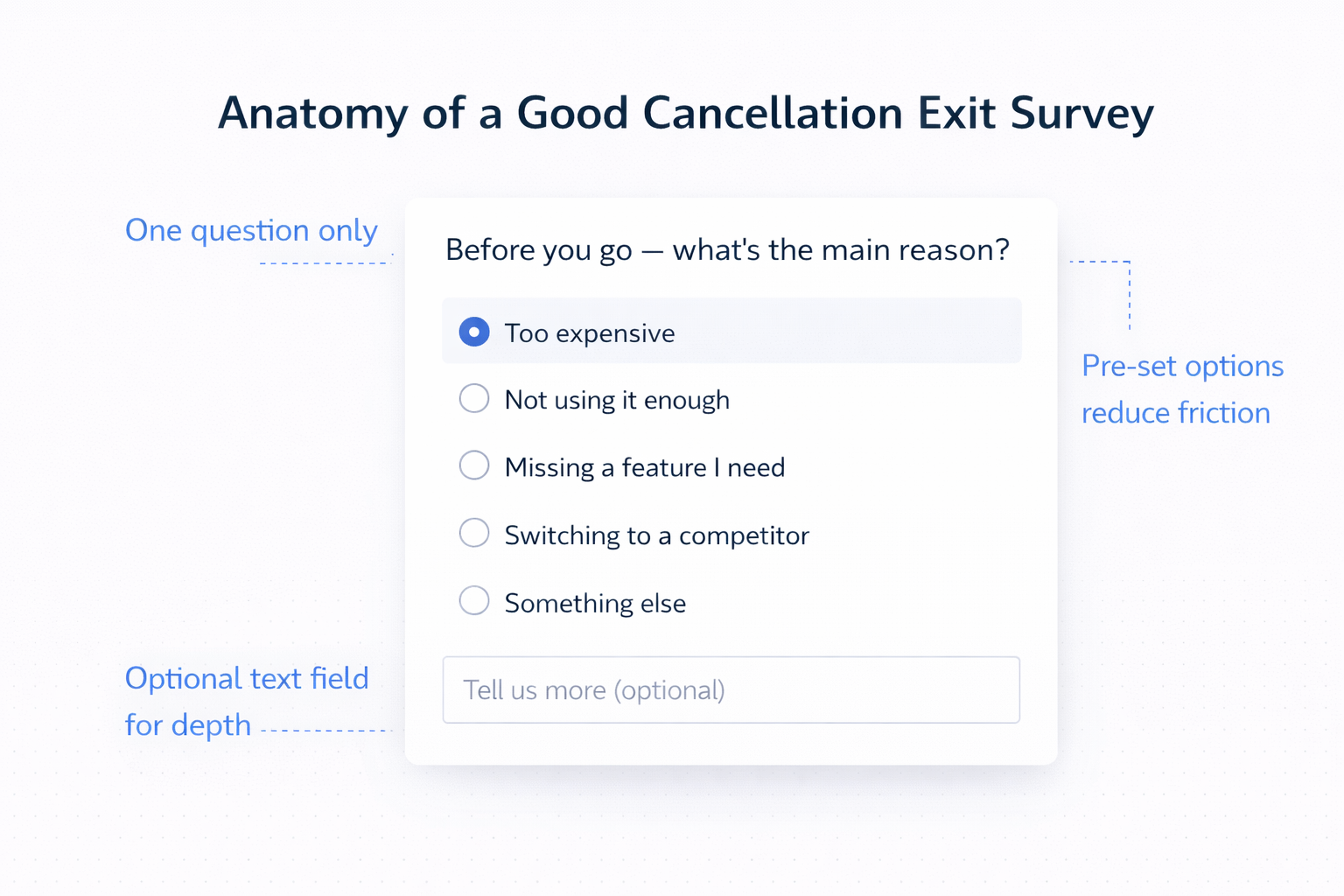
A cancellation exit survey should be brief, focused, and required before the final step. Keep it to one or two questions with pre-set options (e.g., "Too expensive," "Not using it enough," "Missing a feature") plus an optional open text field.
What you do with that data matters just as much as collecting it:
- Tag responses by category to spot patterns over time
- Route high-value churners to a retention specialist or personalized offer
- Feed insights back into product and pricing decisions
Platforms that give you built-in churn analytics make this feedback loop far easier to close. With the right data in hand, you're ready to design a flow that responds intelligently to each subscriber's specific reason for leaving.
Step 2: Design an Engaging Cancellation Flow
With your churn data analyzed and customer feedback in hand, you're ready to build a cancellation flow that actually works. Churn reduction doesn't happen by accident — it's the result of a deliberately structured experience that meets users at their moment of doubt and responds with relevance.
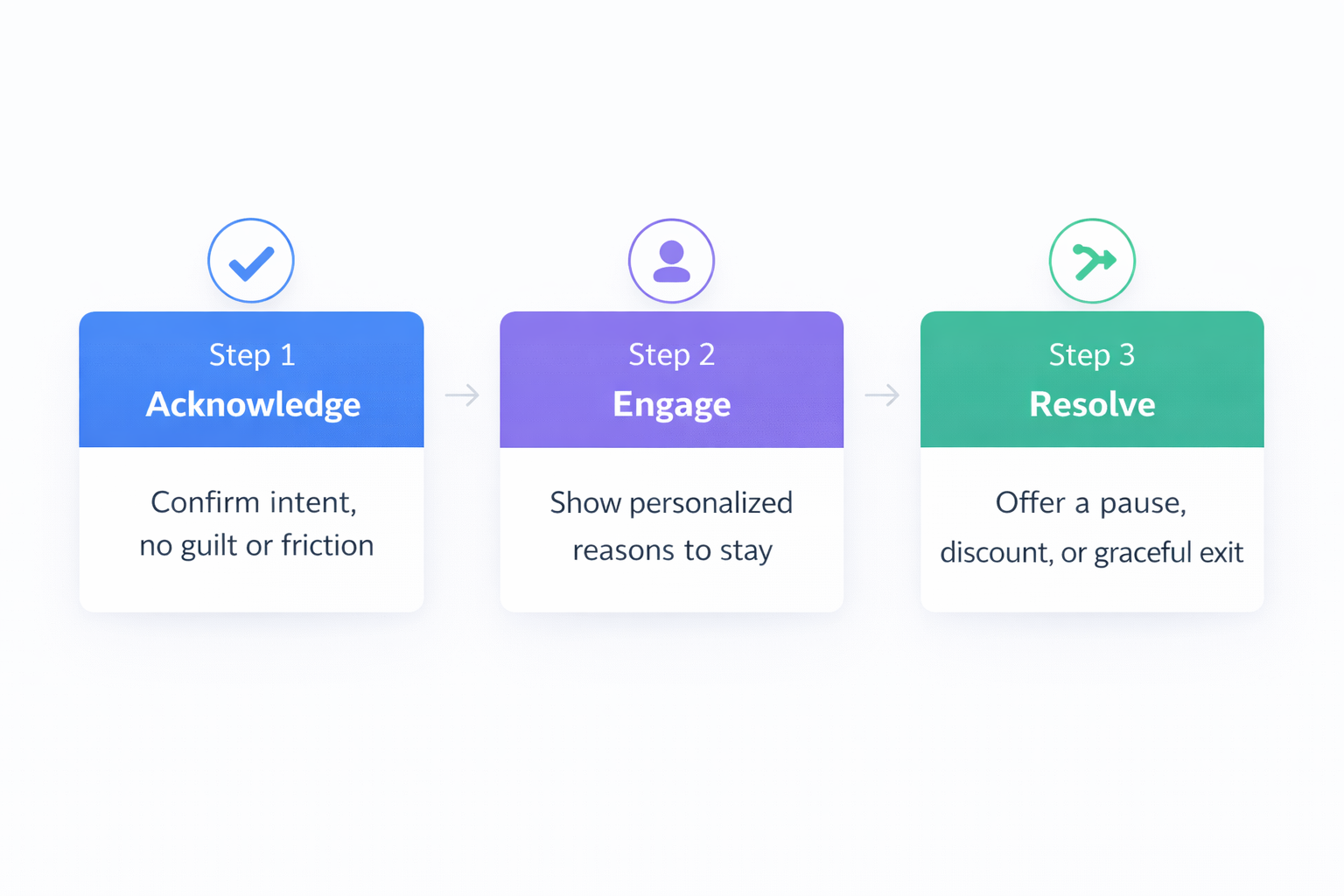
A well-designed cancellation flow typically follows a three-stage structure:
- Acknowledge — Confirm the user's intent without friction or guilt-tripping
- Engage — Present personalized reasons to stay, based on their account history
- Resolve — Offer a meaningful path forward, whether that's staying or leaving gracefully
According to The Good, the most effective flows are concise, empathetic, and avoid dark patterns which are intentionally deceptive design choices, like hiding the cancel button, using manipulative language, or adding unnecessary steps, that frustrate users into staying rather than convincing them. Respecting the customer's intelligence is non-negotiable.
One practical approach is to segment your responses based on cancellation reasons collected in the previous step. A price-sensitive user sees a discount; a dissatisfied user sees an apology and a solution. Winback offers, targeted incentives presented at the right moment, can recover a meaningful share of at-risk subscribers before they ever complete cancellation. For Shopify merchants, tools that automate retention offers intelligently can make this segmentation scalable.
Beyond offers, consider what happens after someone clicks cancel. The next section explores how pauses and discounts expand your retention toolkit even further.
Incorporating Subscription Pauses and Discounts
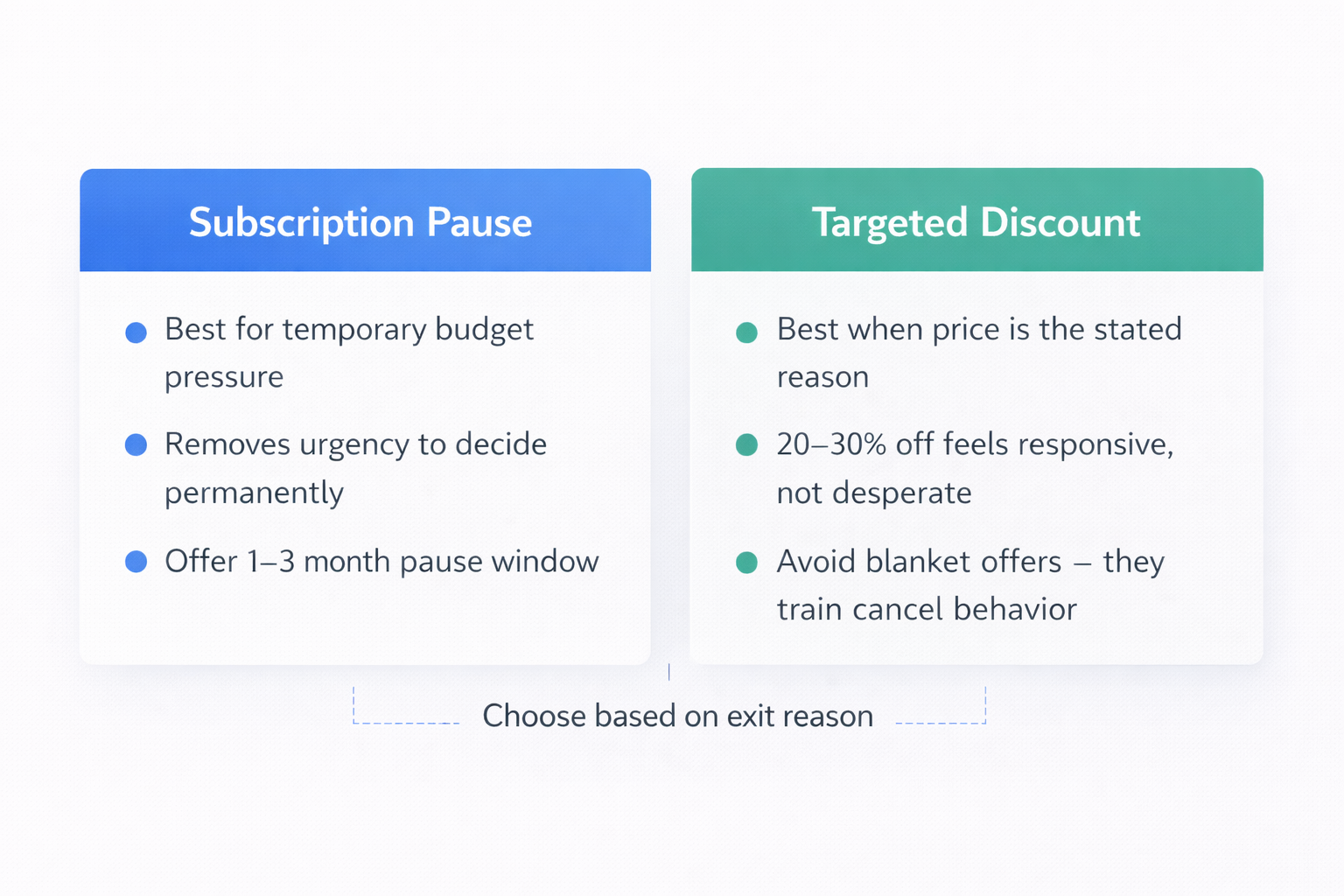
Once your cancellation flow's structure is in place, the real power comes from the retention offers embedded within it. Two of the most effective churn reduction strategies are subscription pauses and targeted discounts, tools that address voluntary churn directly by giving customers an alternative to leaving altogether.
A pause option is often an underutilized lever in a cancellation flow. Many subscribers don't want to cancel permanently; they're responding to a temporary budget squeeze, a travel period, or simple fatigue. Offering a one- to three-month pause removes the pressure to make a permanent decision. According to best practices from Ordergroove, presenting flexible options like pausing meaningfully increases the likelihood a subscriber stays long-term.
Discounts work best when tied to the feedback you've collected. If a customer cites price as their reason for leaving, a targeted 20–30% offer feels responsive rather than desperate. However, deploy discounts selectively, blanket offers can train customers to cancel just to receive a deal.
In practice, pairing these options with flexible subscription management tools makes implementation far smoother. With the right offers mapped, you're ready to move into actually building and testing the flow.
Step 3: Implement and Test the Flow
Designing your cancellation flow is only half the battle — putting it into production and validating its performance is where the real work begins. A thoughtfully built cancellation process can significantly reduce subscription churn, but only if it's implemented correctly and continuously refined.
Start with a staged rollout. Rather than pushing your flow live to all users at once, test it with a smaller segment first. This limits risk and gives you clean performance data before full deployment.
From there, A/B testing becomes your most reliable tool. Test one variable at a time — the headline on your retention offer, the timing of a discount prompt, or the placement of a subscription pause option. What typically happens is that small copy changes produce surprisingly large differences in save rates.
Key metrics to track include:
- Save rate (percentage of cancellations reversed)
- Offer acceptance rate per retention option
- Post-save churn rate (did the save actually stick?)
For subscription businesses running on Shopify, tracking your churn metrics in real time makes it far easier to spot when a flow element underperforms and needs adjustment.
A cancellation flow that isn't measured is simply a door — not a retention strategy.
Even a well-designed flow can undermine itself through poor execution. As you build, it's worth knowing which implementation mistakes most commonly sabotage results — which we'll cover next.
Common Mistakes to Avoid
Even well-intentioned cancellation flows can undermine subscriber retention if they fall into a few predictable traps. Knowing what not to do is just as important as knowing what works.
Overloading subscribers with offers. Presenting too many retention options at once — a discount, a pause, a downgrade, and a free month — creates decision paralysis. One targeted offer, chosen based on the cancellation reason selected, consistently outperforms a cluttered menu of alternatives.
Hiding the cancel button. Dark patterns frustrate users and damage brand trust. A cancellation flow should feel like a respectful conversation, not an obstacle course. Subscribers who feel manipulated rarely return.
Skipping the exit survey. Bypassing cancellation reasons to streamline the flow means losing the qualitative data needed to improve your product. That feedback is how you track churn patterns over time and make smarter retention decisions.
Treating all subscribers the same. A long-tenured subscriber and a two-week trial user warrant different responses. Segment your offers accordingly.
Avoiding these missteps is foundational if you want to build better cancellation flows that hold up at scale — something the real-world examples in the next section illustrate clearly.
Example Scenarios: Successful Cancellation Flows
Seeing these principles in action makes them far easier to apply. The following scenarios illustrate how different subscription businesses have structured their cancellation flows to meaningful effect.
Example Scenario: SaaS productivity tool A mid-market SaaS platform places a brief exit survey immediately after a user clicks "cancel." The survey asks one targeted question — "What's the primary reason you're leaving?" — and routes responses automatically. Users citing price receive a discounted plan offer; those citing complexity are directed to onboarding resources. This single branching decision noticeably reduces immediate churn.
Example Scenario: E-commerce subscription box A DTC brand prompts subscribers to create a cancellation survey with three questions covering product satisfaction, delivery experience, and pricing. Based on responses, the flow surfaces a "skip next box" option rather than full cancellation — a low-friction alternative that retains many would-be churners.
In both cases, the flows share a common trait: they treat cancellation as a conversation, not a transaction. Businesses using subscription analytics tools to track exit-survey data consistently uncover actionable patterns that inform product improvements over time.
Of course, even well-executed flows operate within real-world constraints — something worth examining closely before drawing conclusions.
Limitations and Considerations
Even the most thoughtfully designed cancellation flow has boundaries. Understanding where these strategies fall short helps set realistic expectations before you invest heavily in optimization.
Not every churning subscriber can be saved. Some users have genuinely outgrown a product, hit a budget constraint, or found a better-fit alternative. No amount of personalization or clever offer design will reverse those decisions—and attempting to do so too aggressively can damage brand trust permanently.
A well-built self-service cancellation process respects user autonomy. When subscribers feel pressured or manipulated, they're less likely to return later, and more likely to leave negative reviews. The goal is retention with dignity, not retention at any cost.
It's also worth noting that what works in the best cancellation flow examples for enterprise SaaS may not translate directly to e-commerce subscriptions or mobile apps. Context shapes everything—audience, price point, product category, and platform all influence which tactics resonate.
These flows require ongoing maintenance. Consumer expectations shift, and a flow that performed well last year may feel stale or tone-deaf today. Building automated, flexible cancellation experiences into your subscription infrastructure makes iteration far more manageable over time.
With these caveats in mind, the core principles behind effective cancellation flows remain consistent—and those are worth distilling into clear, actionable takeaways.

Key Takeaways
Building a cancellation flow that reduces subscription churn isn't about trapping customers — it's about understanding them at their most vulnerable moment and responding with genuine value. When done well, a well-designed exit experience can transform a frustrated canceler into a loyal, long-term subscriber.
Here's a quick synthesis of what matters most:
- Make it easy, not obstructive — friction frustrates; clarity retains
- Offer alternatives first — always present an option to pause subscription before finalizing a cancellation
- Personalize the save offer — a generic discount rarely outperforms a targeted, relevant intervention
- Collect exit data — every cancellation reason is a product improvement signal
- Test and iterate — cancellation flow best practices evolve alongside customer expectations
The businesses that win at retention don't view cancellations as failures. They view them as feedback loops. If you're managing subscriptions on Shopify, reducing churn through automation can meaningfully accelerate that learning curve.
Begin with one improvement this week. Audit your current exit flow, identify the weakest step, and fix it. Small, deliberate changes compound quickly — and your retention rate will reflect that.